
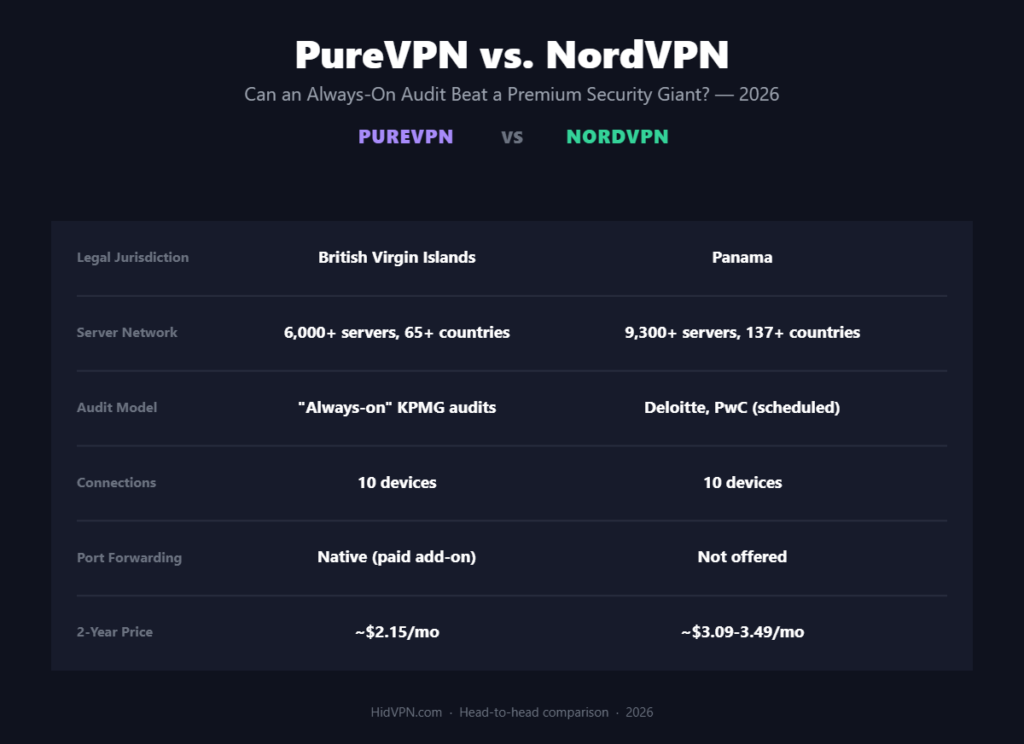
PureVPN vs. NordVPN is a fight between two very different kinds of trust. PureVPN has been around since 2007, which sounds like a point in its favor until you remember it spent the late 2010s digging out of a serious reputation problem. Since then it’s rebuilt itself almost from scratch: new jurisdiction, upgraded hardware, and an audit policy that’s genuinely unusual in this industry. NordVPN, meanwhile, never had that kind of scandal to recover from — it’s simply been one of the most consistent names in the space for years.
So the question isn’t really “which VPN is better” in the abstract. It’s whether PureVPN’s rebuilt, heavily-audited, budget-friendly pitch is enough to beat NordVPN’s speed and polish. We compared both head-to-head on price, trust, network performance, and features to find out.
Table of Contents
Head-to-Head Specification Sheet
| Feature Category | PureVPN | NordVPN |
|---|---|---|
| Legal Jurisdiction | British Virgin Islands | Panama |
| Server Fleet | 6,000+ servers in 65+ countries | 9,300+ servers in 137+ countries |
| Simultaneous Connections | 10 devices | 10 devices |
| Port Infrastructure | 20 Gbps nodes | 10–20 Gbps nodes |
| Audit Protocol | “Always-on” surprise audits (KPMG) | Periodic scheduled audits (Deloitte, PwC) |
| P2P Port Forwarding | Supported (paid add-on) | Not offered |
| Specialty Servers | Quantum-resistant, Dedicated IP, Multi-Hop | Threat Protection Pro, Meshnet, Double VPN |
| Starting Price (2-Year Plan) | ~$2.15/month | ~$3.49/month |
Round 1: Pricing Structures and Renewal Friction
PureVPN’s Pricing Framework
PureVPN goes straight for the budget shopper. Its standard 2-year plan starts around $2.15 a month, undercutting NordVPN by a wide margin, and it throws in a 31-day money-back window — one day longer than the usual industry standard, for what that’s worth.
The catch shows up at renewal. The promotional rate jumps considerably once the introductory term ends, and the checkout flow is stacked with upsells — dedicated IPs, DDoS protection, port forwarding — that can inflate your total before you’ve even finished signing up.
NordVPN’s Pricing Framework
NordVPN costs more up front, starting at around $3.49 a month on a 2-year term. What you get in exchange is clarity: its Basic, Plus, and Complete tiers spell out exactly what’s included at each price point, and the checkout process doesn’t lean nearly as hard on add-on upsells.
- Round 1 Winner: PureVPN. The lower entry price and slightly longer refund window make it the easier initial purchase — just budget for the renewal jump.
Deciding on price alone?
Round 1 went to PureVPN on entry price and refund window. Promotions on both change often, so check the live price rather than the figures above.
Check current PureVPN pricingCheck current NordVPN pricing
Affiliate links — no extra cost to you, and they don’t change how we score. Affiliate disclosure.
Round 2: The Reputation Battle
PureVPN’s 2017 Wake-Up Call
In 2017, PureVPN handed over connection logs to the FBI during a federal cyberstalking investigation, while actively marketing itself as a “zero-logs” provider. It hadn’t logged traffic content, but it had logged real IP addresses and connection timestamps — exactly the kind of data a zero-logs VPN shouldn’t have.
To its credit, PureVPN didn’t just apologize and move on. In late 2021 it relocated its legal registry from Hong Kong to the British Virgin Islands, and it set up an industry-first arrangement with KPMG: auditors can inspect its servers and infrastructure unannounced, at any time, with no advance warning. Four consecutive surprise audits later, the results keep confirming no logs are being stored.
NordVPN’s Clean Slate
NordVPN has never had a comparable scandal. It operates from Panama and backs its no-logs claims with periodic audits from Deloitte and PwC. Those audits are thorough, but they’re scheduled in advance — nothing like PureVPN’s unannounced-inspection model.
- Round 2 Winner: PureVPN. NordVPN’s record is spotless, but PureVPN’s “always-on” surprise-audit arrangement is about as far as active transparency currently goes in this industry.
Round 3: Server Fleets, Port Infrastructure, and Speed
PureVPN’s 20 Gbps Upgrade
PureVPN runs 6,000+ servers across 65+ countries, and it upgraded its main locations to 20 Gbps ports to handle heavier, bandwidth-hungry connections. It defaults to standard WireGuard rather than a custom protocol, and independent reviewers have noted less consistent speeds on Windows clients, particularly on long-distance routes.
NordVPN’s Performance Edge
NordVPN’s fleet is bigger — 9,300+ servers in 137+ countries — and it runs on NordLynx, its own WireGuard-based protocol. It’s the more consistent performer in independent speed testing, holding a high share of baseline speed on local servers with stable latency, which matters more for gaming and large downloads than raw port capacity does.
- Round 3 Winner: NordVPN. PureVPN’s port upgrades help, but NordLynx still delivers faster, more consistent speeds across both short and long-distance connections.
Round 4: Advanced Features and Torrenting
PureVPN’s Power Tools
PureVPN’s native port forwarding (a paid add-on) is genuinely useful for torrenting — it lets you get around router-level firewall restrictions and connect directly to peers, which helps seeding speeds on private trackers. It’s also rolled out quantum-resistant encryption across its network, aimed at protecting data from being decrypted by future quantum computing.
NordVPN’s Toolkit
NordVPN’s Threat Protection Pro scans downloaded files for malware and blocks malicious sites at the network level, even when the VPN itself is off. Meshnet lets you link your own devices together over encrypted tunnels, and Double VPN routes your traffic through two countries for extra encryption.
- Round 4 Winner: NordVPN. PureVPN’s port forwarding and quantum-resistant keys are solid, but Threat Protection Pro and Meshnet are more useful day-to-day for most people.
PureVPN vs. NordVPN: The Final Verdict
Choose PureVPN if:
- You want the highest standard of active audit transparency, via unannounced KPMG inspections.
- You’re fine with a British Virgin Islands jurisdiction and want the lowest starting price, around $2.15/month.
- You torrent seriously and need native port forwarding to maximize seeding on private trackers.
Choose NordVPN if:
- Speed, low latency, and gaming performance are your priority.
- You want active, network-level malware scanning built in (Threat Protection Pro).
- You want Meshnet for linking your own devices securely, or Panama’s unblemished privacy record.
If you’re a torrent enthusiast who wants port forwarding, or you simply want to back a provider using radically transparent “always-on” audits, PureVPN is a strong, budget-friendly pick. But for most people who want the fastest, most reliable, and most feature-rich all-around VPN, NordVPN is still the stronger choice.
Ready to decide?
Whichever way you went above, check the current price before you commit — both providers change promotions regularly.
Check current NordVPN pricingCheck current PureVPN pricing
These are affiliate links. They cost you nothing extra and don’t affect how we score providers — see our affiliate disclosure.
Sources
- tabswire.com
- vpnfin.com
- vpntex.com
- purevpn.com
- tomsguide.com
- pcmag.com
- security.org
- gizmodo.com
- vpnmentor.com