
NordVPN and ExpressVPN are the two names that come up in almost every “best VPN” conversation, and for good reason — both have been through independent no-logs audits, both run RAM-only server networks, and both have been doing this long enough to have survived real-world scrutiny (including, in ExpressVPN’s case, an actual server seizure by Turkish authorities that turned up nothing).
But 2026 has been a year of real changes for both companies. ExpressVPN quietly moved away from its old one-size-fits-all pricing and now sells three separate tiers. NordVPN keeps expanding its server footprint. So the comparison that made sense a year or two ago doesn’t necessarily hold up today. We went through both providers’ current specs, pricing, and feature sets to see where they stand next to each other — you can also see the full lineup on our VPN comparison page.
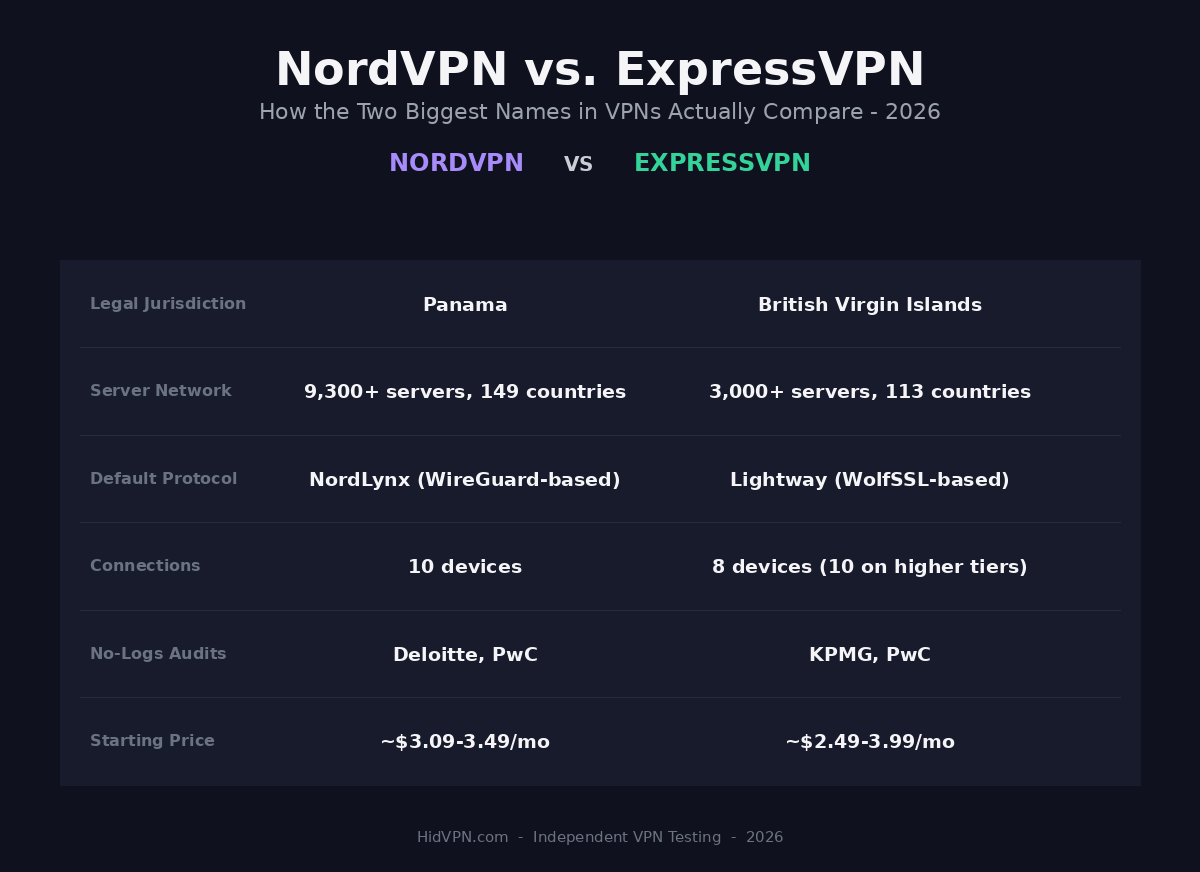
Table of Contents
Quick Comparison
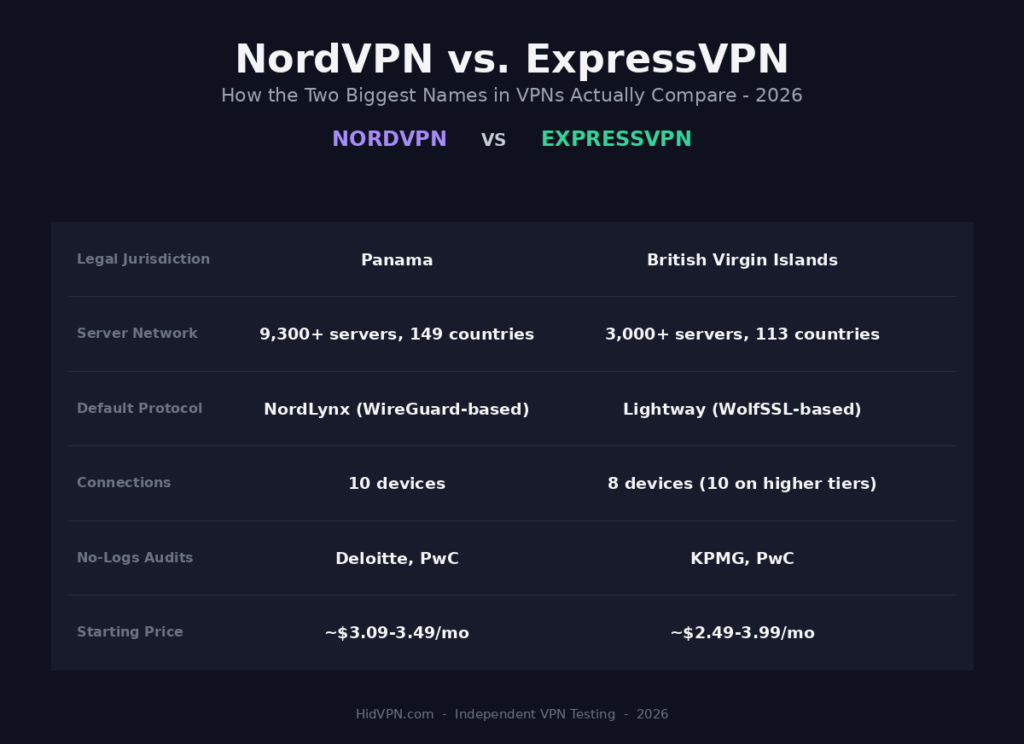
| NordVPN | ExpressVPN | |
|---|---|---|
| Jurisdiction | Panama | British Virgin Islands |
| Server network | ~9,300+ servers, ~149 countries | ~3,000+ servers, 113 countries (214+ locations) |
| Default protocol | NordLynx (WireGuard-based) | Lightway (WolfSSL-based) |
| Simultaneous connections | 10 devices | 8 devices (up to 10 on higher tiers) |
| Independent no-logs audits | Deloitte, PwC | KPMG, PwC |
| Starting price (longest term) | ~$3.49/mo (Basic, 2-year) | ~$2.49–3.99/mo (Basic, 1–2 year) |
| Standout extras | Threat Protection Pro, Double VPN, Onion over VPN | Built-in password manager, Aircove router, automatic obfuscation |
Pricing shown reflects each provider’s cheapest long-term tier at the time of writing. Both companies run frequent promotions and have both moved to multi-tier pricing recently, so check current rates before buying — the numbers above will drift.
Pricing: Closer Than It Used to Be
This is the section that’s changed the most. NordVPN split into four tiers a while back — Basic, Plus, Complete, and Prime — with each one layering in more extras (password manager, cloud storage, ID theft monitoring) on top of the core VPN. Its cheapest long-term option, Basic on a 2-year term, runs a little over $3 a month.
ExpressVPN used to be the outlier — one plan, one price, no tiers, and a noticeably higher monthly cost than NordVPN. That’s no longer true. ExpressVPN restructured into three tiers of its own in 2026 (Basic, Advanced, and Pro), and its cheapest long-term Basic plan now lands close to, and in some promotional periods below, NordVPN’s starting price. The Advanced and Pro tiers add a password manager, identity monitoring, and dedicated IPs — similar territory to what NordVPN’s higher tiers offer.
The upshot: the old “NordVPN is just cheaper” story doesn’t really hold anymore. Both providers now compete on price at the entry tier, and which one is cheaper on a given day depends on whatever promotion is running. If price is your main factor, compare both providers’ current entry-tier rate directly before you commit rather than assuming either one wins by default.
Speed and Connection Protocols
Both providers built their own protocol rather than relying on stock WireGuard or OpenVPN. NordVPN’s NordLynx is a WireGuard implementation tuned for its own infrastructure; ExpressVPN’s Lightway is a from-scratch protocol built on the WolfSSL library, designed in particular to reconnect fast when you switch networks — like when your phone drops WiFi and jumps to mobile data.
In independent reviews published by other sites, NordVPN has generally shown a slight edge in raw throughput on both nearby and long-distance server connections, while Lightway tends to hold its own advantage in reconnection speed and consistency after a network switch. Neither is a bad choice for video calls or downloading large files — the practical difference between them is smaller than the marketing from either company suggests, and it can vary by region and time of day. If you want hard numbers for your specific location, run a speed test on both from where you live rather than relying on any single review’s benchmark.
Security Features
Both use AES-256 encryption as a baseline, but they differ on what else comes bundled in.
NordVPN leans into being a broader security suite rather than just a tunnel. Threat Protection Pro scans downloaded files for malware and blocks malicious sites at the network level — notably, it keeps working even when the VPN itself is switched off. NordVPN also offers Double VPN (routing through two countries for layered encryption), Onion over VPN (Tor network access without a separate Tor browser), and obfuscated servers, which disguise VPN traffic so it isn’t easily flagged by restrictive networks or firewalls — a legitimate and common use case in countries with heavy internet censorship.
ExpressVPN takes a quieter approach: its servers detect a restrictive network on their own and apply obfuscation automatically, rather than requiring you to pick a specific server type. Every plan includes a built-in password manager (ExpressVPN Keys), and its Threat Manager blocks trackers and known-malicious sites, though it doesn’t scan local file downloads the way Nord’s Threat Protection Pro does.
If you specifically want file-scanning malware protection and multi-hop routing as standard features, NordVPN’s toolkit is broader out of the box.
Privacy, Jurisdiction, and Audits
Where a VPN is legally based matters, because it determines what a government can compel the company to hand over.
NordVPN is based in Panama — outside the Five/Nine/Fourteen Eyes intelligence-sharing alliances, with no mandatory data retention law. Its no-logs claims have been independently audited multiple times, most recently by Deloitte and PwC, and the entire server fleet runs on RAM-only (diskless) hardware, meaning nothing persists if a server loses power or gets physically seized.
ExpressVPN is based in the British Virgin Islands, another jurisdiction with no local data retention requirement. Its “TrustedServer” architecture was one of the earliest RAM-only implementations in the industry, audited by KPMG and PwC. The claim was tested for real in 2017, when Turkish authorities seized one of ExpressVPN’s physical servers during a criminal investigation and found no usable logs on it — about as strong a real-world proof point as a no-logs policy can get.
On privacy fundamentals, it’s a toss-up. Both have credible, independently verified no-logs records and jurisdictions that don’t force data retention.
Travel and Public Wi-Fi
Most people who buy a VPN end up using it on networks they don’t control: hotel, airport and café Wi-Fi, or a connection while travelling.
NordVPN includes Threat Protection, which blocks known malicious sites and many trackers, a useful extra on shared networks. Its kill switch cuts your traffic if the VPN connection drops, so nothing slips out unprotected while you move between networks.
ExpressVPN’s Lightway protocol is designed to reconnect quickly when your device switches networks, for example from hotel Wi-Fi to mobile data, and its Network Lock kill switch does the same job as NordVPN’s.
Both are solid here. NordVPN adds more built-in protection extras; ExpressVPN focuses on fast, low-effort reconnection.
Apps and Everyday Usability
NordVPN’s app uses a map-based interface — visually clear about where your traffic is routing, though it can feel a little busy on a small phone screen. It covers Windows, macOS, Linux, Android, iOS, and Android TV, plus a well-built native Apple TV app.
ExpressVPN goes the other direction: a single big connect button, a simple location picker, and everything else tucked into a menu. It’s about as approachable as a VPN app gets for someone who doesn’t want to think about settings. Where it pulls ahead is router support — ExpressVPN sells its own pre-configured router, Aircove, and offers custom firmware for other routers, which makes whole-home coverage considerably easier to set up than piecing it together yourself.
Which One Should You Get?
NordVPN makes more sense if you want the broadest built-in security toolkit (malware scanning, multi-hop, Tor integration), or you’re already comparing tiered plans and want to pick exactly which extras you’re paying for.
ExpressVPN makes more sense if you want the simplest possible app experience, you want easy whole-home router coverage without configuring firmware yourself, or you travel through countries with aggressive network restrictions and want obfuscation that kicks in automatically instead of needing to select it manually.
On price, it’s no longer the clear NordVPN win it used to be — check both providers’ current entry-tier rate before deciding, since it changes with promotions on both sides.
Realistically, you’d be well served by either. The bigger factor for most people is which app and feature set fits how they use a VPN day to day, not which one wins a spec sheet. For the full lineup of providers we’ve tested, see our complete VPN comparison table.