
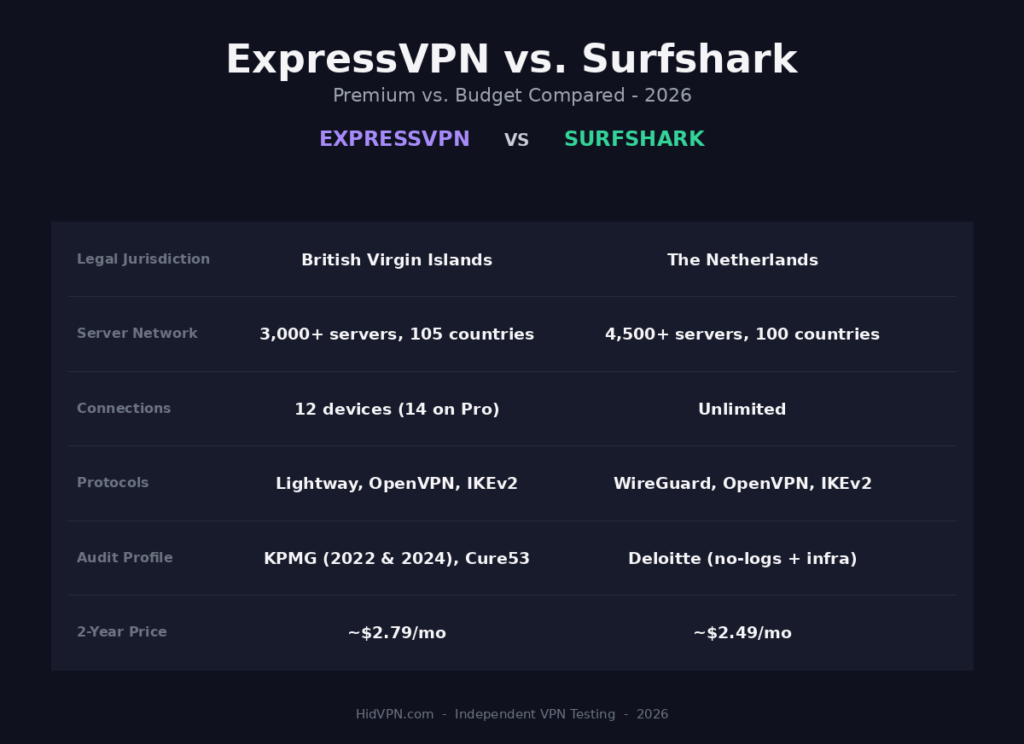
ExpressVPN vs. Surfshark sit at opposite ends of the same shelf. See our full ExpressVPN review and Surfshark review for more. One built its reputation as the polished, no-compromise premium option that security reviewers reach for first[6][11]. The other built its reputation by refusing to charge premium prices while still keeping pace on features[1][2]. Both now run RAM-only server fleets, both have survived independent no-logs audits, and both allow P2P traffic across their entire networks rather than funneling torrent users onto a handful of designated servers[1][9].
The gap between them used to be simple: pay more for ExpressVPN’s polish, or pay less and live with Surfshark’s rougher edges. That gap has narrowed considerably. Surfshark’s WireGuard implementation now outpaces ExpressVPN’s proprietary Lightway protocol in independent speed testing[1][15], while ExpressVPN has spent 2026 leaning harder into jurisdiction, audit frequency, and a genuinely useful hardware ecosystem (Aircove routers, a standalone password manager) to justify its higher price[6][12][13].
This comparison breaks down where each provider actually wins, so you can decide whether ExpressVPN’s premium positioning is worth the extra cost, or whether Surfshark’s value proposition holds up under scrutiny.
Table of Contents
- Head-to-Head Specification Sheet
- Round 1: Pricing Plans and Value Packages
- Round 2: Speed, Latency, and Network Infrastructure
- Round 3: Security, Privacy, and Jurisdictional Standing
- Round 4: Streaming, Torrenting, and Bypassing Blocks
- Round 5: Interface, Usability, and Advanced Features
- ExpressVPN vs. Surfshark: The Final Verdict
- Sources
Head-to-Head Specification Sheet
| Feature Category | ExpressVPN | Surfshark VPN |
|---|---|---|
| Legal Jurisdiction | British Virgin Islands[6][7] | The Netherlands[2][6] |
| Server Network | 3,000+ servers, 105 countries (exact count no longer disclosed)[1][11] | 4,500+ servers in 100 countries[1][2] |
| Simultaneous Connections | 12 devices (Advanced), 14 devices (Pro)[5][14] | Unlimited[1][2] |
| Connection Protocols | Lightway (proprietary), OpenVPN, IKEv2[1][8] | WireGuard, OpenVPN, IKEv2[1][2] |
| Audit Profile | No-logs audited by KPMG (2022 & 2024); TrustedServer and Lightway independently audited by Cure53[6][8][11] | No-logs and infrastructure audited by Deloitte[1][2] |
| Basic 2-Year Price | ~$2.79/month (Basic tier, plus bonus months)[3][4] | ~$2.49/month[2] |
| Streaming & P2P | Fully supported on all servers; MediaStreamer Smart DNS included[1][9][10] | Fully supported on all servers[1][2] |
Round 1: Pricing Plans and Value Packages
ExpressVPN’s Tiered Structure
ExpressVPN moved to a three-tier model, replacing its old one-size-fits-all subscription[3][11]:
- Basic: Core VPN access, Lightway protocol, and the full server network. On a 2-year term this runs about $2.79/month (with bonus months added); the annual plan is $3.99/month, and month-to-month pricing jumps to $12.99/month[3][4].
- Advanced: Adds the Keys password manager, Advanced Protection (ad, tracker, and malware blocking), and Identity Monitoring with fraud alerts, plus support for up to 12 simultaneous devices. Pricing starts around $4.49/month on a long-term plan[5][12].
- Pro: Bundles everything in Advanced with dedicated IP options and support for up to 14 devices. Long-term pricing starts near $5.99/month, rising to $19.99/month if paid monthly[3][5].
Surfshark’s Tiered Structure
Surfshark’s three tiers remain the cheapest entry point in this comparison by a wide margin[2]:
- Surfshark Starter: Full VPN service, Dynamic MultiHop, cookie pop-up blocker, and Alternative ID. On the 2-year plan, this costs roughly $2.49 per month[2].
- Surfshark One: Adds antivirus, webcam protection, breach alerts, and an ad-free private search engine, landing around $2.08 to $2.39 per month[2].
- Surfshark One+: Includes a full Incogni subscription for data-broker removal requests, priced around $3.99 to $4.18 per month[2].
The Device Factor: 12-14 vs. Unlimited
Even ExpressVPN’s Pro tier caps out at 14 devices[5][14]. Surfshark places no cap on simultaneous connections at any tier[1][2]. For households running smart TVs, phones, laptops, and streaming boxes simultaneously, that’s a structural advantage no amount of ExpressVPN polish offsets.
- Round 1 Winner: Surfshark. It undercuts ExpressVPN at every tier[2][3], and the total absence of a device cap makes the value gap even wider than the sticker prices suggest[1][2].
Round 2: Speed, Latency, and Network Infrastructure
Both providers rely on modern, high-throughput server hardware, but the protocols doing the actual work are different generations of technology[1][8].
Surfshark: The Leaner Protocol
Independent multi-region testing found Surfshark’s WireGuard implementation retaining a worldwide average of roughly 95% of unprotected download speeds, even while running 40 Gbps-capable infrastructure on both sides of the comparison[1][15]. WireGuard’s smaller codebase and lower encryption overhead give it a structural edge over older or heavier protocol implementations[1].
ExpressVPN: Reliable, Not Fastest
ExpressVPN’s Lightway protocol, built on the WolfSSL library, is designed primarily around fast reconnection when switching networks — for example, when a phone jumps from WiFi to mobile data[8]. In the same independent testing, ExpressVPN averaged around 75% speed retention globally, noticeably behind Surfshark’s WireGuard numbers[1][15]. ExpressVPN also no longer publishes an exact server count, which makes it harder to verify network density claims independently[1][11].
- Round 2 Winner: Surfshark. Its WireGuard implementation delivers meaningfully better real-world download speed retention than ExpressVPN’s Lightway protocol in independent, multi-region testing[1][15].
Round 3: Security, Privacy, and Jurisdictional Standing
Both companies are transparent about where they’re incorporated and how often they’ve been independently checked — but the depth of that verification differs[6][7][11].
ExpressVPN: The BVI Track Record
ExpressVPN is incorporated in the British Virgin Islands, a self-governing British Overseas Territory with no mandatory data retention law and no obligation to share user data under BVI statute[6][7]. Its TrustedServer architecture — RAM-only infrastructure that wipes on every reboot — has been independently audited alongside its no-logs policy by KPMG in both 2022 and 2024[6][11]. The Lightway protocol itself passed a separate Cure53 cryptographic audit[8]. Taken together, ExpressVPN states it has completed and published roughly a dozen third-party audits covering its apps, privacy policy, and core technology in the past year alone[6][11].
Surfshark: Audited, but Fewer Data Points
Surfshark is legally based in the Netherlands, which sits inside the Fourteen Eyes intelligence-sharing network[2][6]. Surfshark’s no-logs claims and RAM-only server fleet have been independently verified by Deloitte, and the company publishes a regular Warrant Canary[2]. That said, Surfshark’s public audit history is thinner than ExpressVPN’s — a single primary auditor versus ExpressVPN’s combination of KPMG, Cure53, and a running annual audit cadence[2][6][11].
Unique Security Add-ons
- Keys / ExpressKeys (ExpressVPN): A built-in password manager, now also available as a standalone app, included on Keys-eligible Advanced and Pro plans[12].
- Threat Manager (ExpressVPN): Blocks known trackers and malicious domains at the network level[6].
- Alternative ID (Surfshark): Generates masked identities and email addresses to reduce exposure to data brokers and spam[2].
- Round 3 Winner: ExpressVPN. BVI’s clean no-retention jurisdiction combined with a longer, more frequently refreshed audit history gives it a slight but real edge over Surfshark’s single-auditor setup[6][7][11].
Round 4: Streaming, Torrenting, and Bypassing Blocks
Unlike some competitors that restrict P2P traffic to designated servers, both ExpressVPN and Surfshark allow torrenting across their entire networks[1][9].
Streaming Performance
Which services work from which servers changes constantly — it varies by platform, by server and by week. We do not test playback against individual services, so we make no claims about it, and treat any page that states it as a fixed fact as describing a snapshot.
The structural points do hold. ExpressVPN’s MediaStreamer Smart DNS lets smart TVs and consoles that cannot run a VPN client route through its network without full encryption, which matters if your TV is the main screen. Surfshark’s unlimited device allowance means several people in a household can hold their own connections at once without competing for slots.
Both hold enough throughput on nearby servers for HD and 4K. Use the refund window to try your own services before committing.
Torrenting and P2P Support
- ExpressVPN: P2P traffic is permitted on every server, with no need to manually select a torrent-friendly location. The service works cleanly with uTorrent, BitTorrent, and qBittorrent[9].
- Surfshark: Same policy — torrenting works on all 4,500+ servers without restriction[1][2].
- Round 4 Winner: Tie. Both providers now handle P2P identically, and each has a specific streaming edge — ExpressVPN’s consistency on major platforms versus Surfshark’s unlimited simultaneous streaming across devices — that cancels the other out[1][2][10].
Round 5: Interface, Usability, and Advanced Features
Where the two providers diverge most is in what they’ve built beyond the core VPN tunnel[12][13].
ExpressVPN’s Ecosystem
ExpressVPN’s interface is famously simple — a single power button and a location picker — but the real differentiator in 2026 is its hardware and software ecosystem. Aircove and the newer, portable Aircove Go are purpose-built routers with ExpressVPN baked directly into the firmware, letting every device on a network route through the VPN without individual app installs[13]. ExpressKeys, its standalone password manager, extends beyond the VPN app itself and is included on Keys-eligible plans[12].
Surfshark’s Ecosystem
Surfshark keeps its core app clean and modular, but backs it with software-side extras: Dynamic MultiHop lets users pick any two countries to route through rather than choosing from ExpressVPN’s fixed options, and Surfshark Nexus uses software-defined networking to route traffic through an optimized web of servers rather than a single fixed connection[2].
- Round 5 Winner: ExpressVPN. Aircove’s dedicated router hardware and the standalone Keys password manager represent a more mature, tangible ecosystem than Surfshark’s software-only extras, even though Surfshark’s Nexus and MultiHop tools are genuinely well-engineered[2][12][13].
ExpressVPN vs. Surfshark: The Final Verdict
Choose ExpressVPN if:
- You want the strongest, most frequently re-verified audit trail in the industry[6][11].
- You prefer British Virgin Islands’ clean, no-retention legal jurisdiction[6][7].
- You want a dedicated VPN router (Aircove) that protects every device on your network automatically[13].
- You want a mature, standalone password manager bundled with your subscription[12].
Choose Surfshark if:
- You want the better price-to-performance ratio, especially on longer terms[2][3].
- You need to protect an unlimited number of devices under a single plan[1][2].
- You want measurably faster real-world download speeds via WireGuard[1][15].
- You want built-in identity tools like Alternative ID without paying extra[2].
This round came down closer than the Surfshark-vs-NordVPN matchup — ExpressVPN’s jurisdiction, audit cadence, and hardware ecosystem are genuine, defensible reasons to pay more[6][11][13]. But for the average household, Surfshark’s unlimited devices, measurably faster protocol, and lower price at every tier make it the harder value proposition to argue against[1][2][15]. ExpressVPN remains the pick for users who want the deepest paper trail on their provider’s trustworthiness; Surfshark remains the pick for everyone else.
Sources
- cyberinsider.com
- surfshark.com
- costbench.com
- security.org
- vpnpro.com
- vpn.com
- expressvpn.com
- techradar.com
- thebestvpn.com
- cyberinsider.com
- comparitech.com
- expressvpn.com
- expressvpn.com
- cybernews.com
- cloudwards.net