
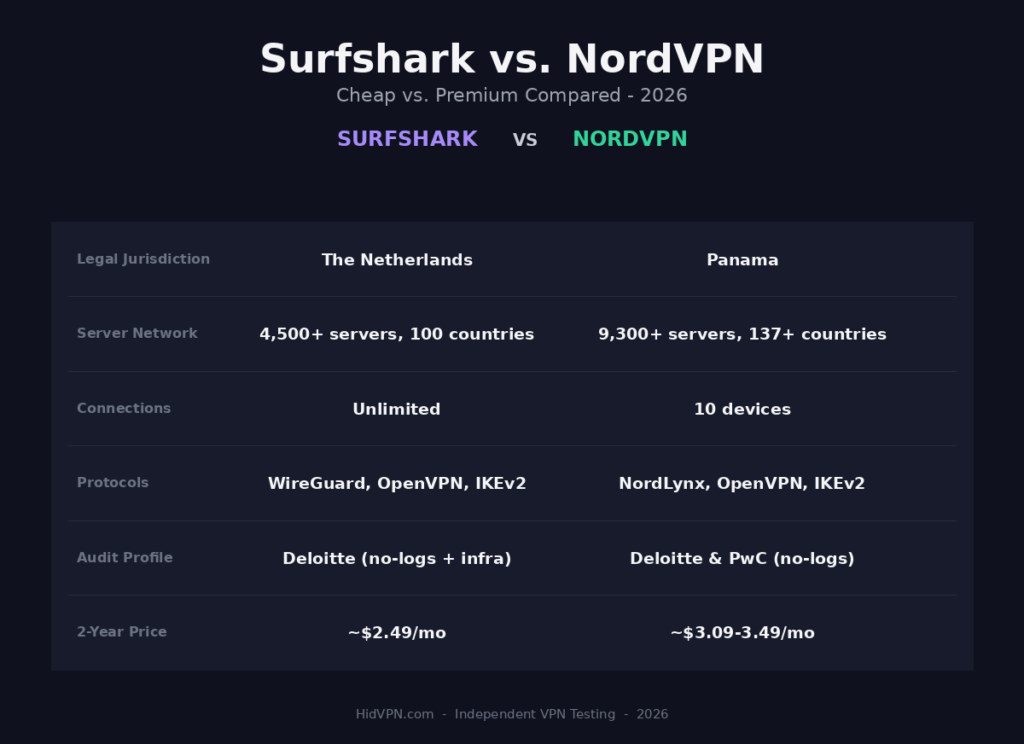
Surfshark vs. NordVPN is the comparison budget-conscious buyers land on eventually when shopping for an elite Virtual Private Network[1]. See our full Surfshark review and NordVPN review for more. While both brands legally merged under the parent entity Nord Security in 2022[1], they continue to operate as strictly independent products with separate development teams, distinct user interfaces, and entirely different server infrastructures[1].
The core division between them is straightforward: NordVPN positions itself as the ultimate, highly polished, premium cybersecurity suite[1], while Surfshark focuses on offering maximum possible value, featuring lower prices and the massive perk of unlimited device connections[1][2].
But is the distinction really that simple? Under the hood, both providers have rolled out major feature upgrades[3][4]. NordVPN has expanded its global server fleet significantly[5], while Surfshark has introduced self-healing connection technology and specialized security suites[3][4].
This comparison is based on each provider’s current published specs, pricing, and features, cross-checked against independent VPN testing publications, to help you decide whether you should pay more for NordVPN or save money with Surfshark[1].
Table of Contents
- Head-to-Head Specification Sheet
- Round 1: Pricing Plans and Value Packages
- Round 2: Speed, Latency, and Network Infrastructure
- Round 3: Security, Privacy, and Jurisdictional Standing
- Round 4: Streaming Performance and Device Coverage
- Round 5: Interface, Usability, and Advanced Features
- Surfshark vs. NordVPN: The Final Verdict
- Sources
Head-to-Head Specification Sheet
| Feature Category | Surfshark VPN | NordVPN |
|---|---|---|
| Legal Jurisdiction | The Netherlands[6] | Panama[6] |
| Server Network | 4,500+ servers in 100 countries[5] | 9,300+ servers in 137+ countries[5] |
| Simultaneous Connections | Unlimited[1][2] | 10 devices[1][2] |
| Connection Protocols | WireGuard, OpenVPN, IKEv2[1][7] | NordLynx (WireGuard-based), OpenVPN, IKEv2[1][6] |
| Audit Profile | No-logs and infrastructure audited by Deloitte[1][3][6] | No-logs audited by Deloitte & PwC[1][6] |
| Basic 2-Year Price | ~$2.49/month[7][8] | ~$3.09 to $3.49/month[5][6] |
| Server Access | All servers available on every plan[1][3] | All servers available; some are use-optimised[1] |
Round 1: Pricing Plans and Value Packages
The primary reason most users consider Surfshark is its price point[8]. However, both brands have transitioned to tiered plan structures[5][9]. To understand the true cost, we have to look closely at what is included in each tier.
Surfshark’s Tiered Structure
Surfshark divides its service into three distinct packages[9]:
- Surfshark Starter: Includes the full VPN service, dynamic multi-hop routing, a robust cookie pop-up blocker, and Alternative ID (a tool that generates a masked email and persona to hide your real identity online)[8][10][11]. On the 2-year plan, this costs a highly economical $2.49 per month[7][8].
- Surfshark One: Adds an integrated antivirus suite, webcam protection, real-time data breach alerts, and a private, ad-free search engine[3][10]. This sits around $2.08 to $2.39 per month on a 2-year commitment[7][8].
- Surfshark One+: Bundles all prior features with a full subscription to Incogni, a privacy service that actively requests the deletion of your personal information from global data broker databases[10]. This tier costs about $3.99 to $4.18 per month[7][8].
NordVPN’s Tiered Structure
NordVPN offers four tiers[5]:
- Basic: Grants access to the core VPN network, high-speed servers, and the NordLynx protocol. It starts at $3.09 to $3.49 per month on a 2-year term[5][6].
- Plus: Integrates NordPass (a premium password manager) and Threat Protection Pro (advanced ad, tracker, and malware scanner).
- Complete: Includes 1 TB of secure, encrypted cloud storage (NordLocker) and data breach scanners.
- Prime: Features premium identity theft insurance protections and file recovery tools.
The Device Factor: 10 vs. Unlimited
Even if the monthly prices were identical, Surfshark would hold a massive value advantage because it allows unlimited simultaneous device connections[1][2]. NordVPN recently raised its limit from 6 to 10 devices[1][2][5], which is generous, but still a hard cap.
If you have a large family, run multiple smart home devices, or simply do not want to worry about being logged out of an app, Surfshark’s lack of caps is a major benefit[1].
- Round 1 Winner: Surfshark. It is significantly cheaper on longer commitments[1][2], and the unlimited simultaneous connection feature offers unmatched value per dollar[1][2].
Round 2: Speed, Latency, and Network Infrastructure
To evaluate connection speeds objectively, we drew on independent speed-test data for both providers across short, medium, and long-range servers[1]. Both rely on 10 Gbps port infrastructure to handle heavy user traffic, but their routing technologies are distinct[12].
NordVPN: Raw Speed Dominance
NordVPN’s proprietary NordLynx protocol consistently clocks some of the fastest download speeds in independent benchmarks[1][6]. On a nearby local server, published speed tests show an average loss of around 18% (retaining roughly 82% of baseline speeds)[1].
More importantly, NordVPN maintains strong stability on long-distance routing[1]. Independent tests connecting from the US to Japan show only around a 24% drop, which is exceptional for cross-oceanic traffic.
Surfshark: Fast, with “Nexus” Integration
Surfshark utilizes standard WireGuard as its default, high-speed protocol[1][6][7]. While not customized in the way NordLynx is, WireGuard on Surfshark is incredibly fast[3]. Independent tests show local servers averaging around a 20% speed loss (retaining roughly 80% of baseline)[1][3].
However, Surfshark’s real speed innovation is Surfshark Nexus[13]. Nexus uses Software-Defined Networking (SDN) to connect all of Surfshark’s individual servers into a singular, unified global network[13]. Instead of routing your connection straight to a single server box, Nexus routes your traffic through an optimized web of servers, improving stability and minimizing connection drops[13].
Surfshark also features a self-healing network technology called Everlink, which automatically repairs connection drops in the background without requiring you to manually reconnect[4].
- Round 2 Winner: NordVPN. While Surfshark’s Nexus and self-healing systems are highly advanced[4][13], NordVPN’s NordLynx protocol still edges it out on raw download speed and lower overall ping during peak traffic hours[1][6].
Round 3: Security, Privacy, and Jurisdictional Standing
While they share a parent company, they reside under very different legal frameworks[1][6]. This shapes how secure your data is from court-ordered subpoenas and local law enforcement.
NordVPN: The Panama Privacy Haven
NordVPN is legally based in Panama[6]. Panama sits completely outside the influence of the Five, Nine, and Fourteen Eyes surveillance networks and has zero domestic laws requiring companies to log or store consumer web history.
Nord’s strict zero-logs claims have been independently audited several times by Deloitte and PwC[1][6]. Its entire hardware fleet consists of diskless, RAM-only servers, ensuring that any user data traversing the network is completely unreadable the moment a machine is turned off or seized.
Surfshark: The Dutch Jurisdiction
Surfshark operates under the corporate jurisdiction of the Netherlands[6][14]. The Netherlands is part of the Fourteen Eyes intelligence-sharing network[3]. While this might sound alarming to privacy purists, Surfshark’s strict operational setup renders this practically irrelevant[3]:
- Surfshark maintains a rigorous no-logs policy that has been audited and verified by Deloitte[1][3][6].
- Like NordVPN, Surfshark uses 100% RAM-only servers[3][4]. Even if Dutch authorities subpoena Surfshark or physically seize a server, there are simply no physical hard drives or log files to extract[3][4].
- Surfshark regularly publishes a Warrant Canary, proving they have never complied with secret government data requests.
Unique Security Add-ons
- Alternative ID (Surfshark): Generates clean, alternative personas, email addresses, and names so you can sign up for websites without exposing your real identity to spam lists or data brokers[11].
- Threat Protection Pro (NordVPN): An active, network-level antivirus system that goes beyond ad blocking, scanning your downloads for hidden malware, warning you about phishing sites, and stripping tracking parameters from URLs.
- Round 3 Winner: NordVPN. Panama’s superior natural privacy jurisdiction gives it a slight legal edge over the Netherlands[6], and Nord’s local file-scanning malware protection is more advanced than Surfshark’s DNS-based filtering.
Round 4: Streaming Performance and Device Coverage
Streaming quality comes down to sustained throughput, not marketing claims. Both providers hold enough headroom on nearby servers for HD and 4K playback; the difference shows up on distant connections and at peak hours, when the gap in raw speed from Round 2 starts to matter.
Streaming Performance
Which services work from which servers changes constantly. It varies by platform, by server and by week, and any page stating it as a fixed fact — including ours — is describing a snapshot rather than a guarantee. We do not test playback against individual services, so we do not make claims about it.
What can be said is structural. NordVPN’s wider country coverage means you are more likely to find a server geographically close to the content you are loading, and physical distance is the single biggest driver of buffering. Surfshark’s advantage is different: with no cap on simultaneous connections, a household can run several sessions at once without competing for device slots.
The practical advice is the same for both: use the refund window to try the services you actually care about before committing. A provider’s location list tells you where its servers are, not what will play.
Device Coverage
Surfshark places no limit on simultaneous connections. NordVPN allows 10. For one person across a phone and a laptop this rarely matters. For a household covering phones, laptops, tablets, a TV and a console, it is the clearest practical difference between the two.
Round 4 verdict: Surfshark, on device coverage alone. Unlimited connections is a concrete, verifiable advantage, and it is the one that affects most households day to day.
Round 5: Interface, Usability, and Advanced Features
The daily user experience depends entirely on the design of the desktop and mobile applications.
NordVPN’s Interface
NordVPN relies on an interactive map interface on desktop and mobile. While highly visual and excellent for seeing your connection routes, navigating the map on a smaller smartphone screen can occasionally feel cluttered.
NordVPN features an incredibly useful Meshnet tool, which lets you securely link your devices together over an encrypted connection. This is excellent for file sharing, local LAN gaming, or accessing your home computer’s IP address while traveling.
Surfshark’s Interface
Surfshark opts for a clean, modular, vertical layout[7]. It is exceptionally easy to navigate for complete beginners[15].
Surfshark also offers a customized Dynamic MultiHop tool[3]. Unlike NordVPN, which only offers pre-set Double VPN pairs, Surfshark allows you to pick any incoming server in Country A and any outgoing server in Country B, giving you complete control over your multi-layered encryption route[3][10].
- Round 5 Winner: Tie. NordVPN’s Meshnet is a revolutionary networking feature, but Surfshark’s clean interface[7], custom Dynamic MultiHop tool[3][10], and Alternative ID generation are equally impressive[11].
Surfshark vs. NordVPN: The Final Verdict
Choose NordVPN if:
- You want the absolute fastest, most stable download speeds over long-haul connections[1].
- You prefer a highly secure legal jurisdiction based in Panama[6].
- You want integrated, advanced malware file scanning (Threat Protection Pro) rather than basic ad blocking.
- You want to create direct, secure device-to-device connections using Meshnet.
Choose Surfshark if:
- You want the absolute best price-to-performance value in the industry[1][3].
- You need to protect an unlimited number of devices under a single subscription[2][15].
- You want custom control over your Double VPN connections (Dynamic MultiHop)[3][10].
- You want built-in identity shielding features like Alternative ID[11].
While NordVPN is the slightly more polished, feature-heavy product, Surfshark is the smarter buy for most everyday consumers[1]. Its extremely low pricing[1][3], comparable speeds[1], audited security measures[1][3], and lack of device caps make it an outstanding value proposition that is hard to ignore[2][3][8].
Sources
- pcmag.com
- surfshark.com
- youtube.com
- pcmag.com
- thebestvpn.com
- comparitech.com
- youtube.com
- security.org
- youtube.com
- pcmag.com
- surfshark.com
- surfshark.com
- surfshark.com
- surfshark.com
- youtube.com