
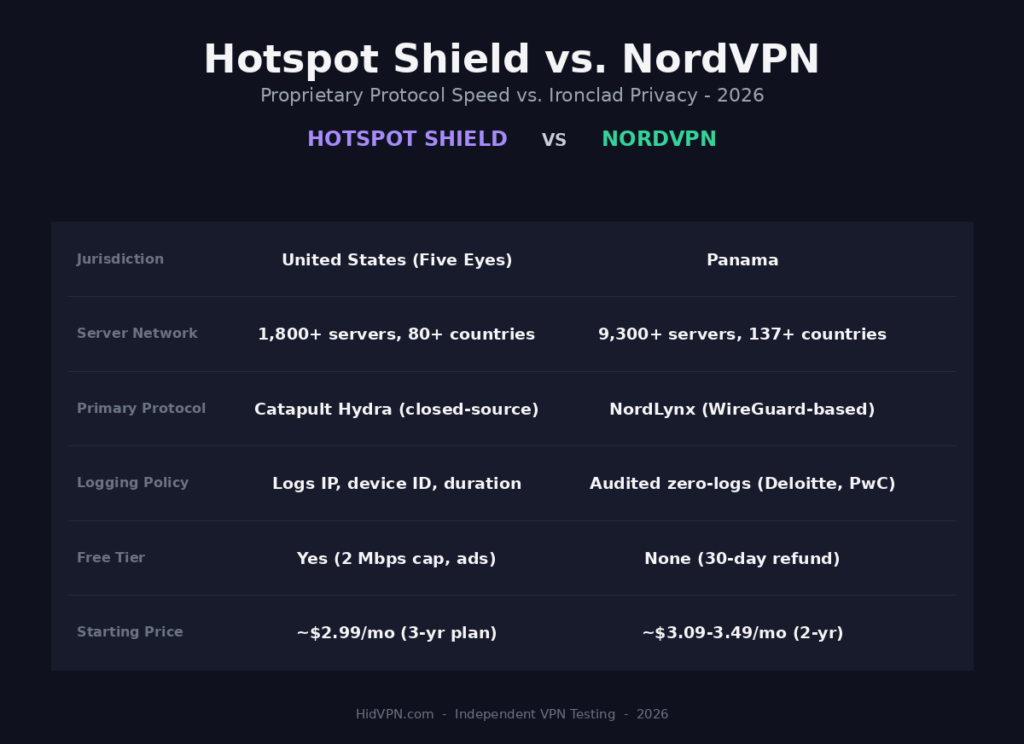
Hotspot Shield vs. NordVPN is a fight between two completely different engineering philosophies. Hotspot Shield built its own closed-source transport protocol, Catapult Hydra, specifically to shave latency off long-distance connections — it was good enough that McAfee and Bitdefender licensed it to run inside their own security suites for years. NordVPN went the other direction: instead of building something proprietary from scratch, it optimized the open-source WireGuard protocol into NordLynx and built its entire brand around verified, audited privacy.
Both approaches have real trade-offs. Hydra is fast but nobody outside Hotspot Shield’s own team can inspect its code for flaws. NordLynx is transparent but had to solve a genuine privacy problem — WireGuard’s own design leaves static IPs sitting on the server — before it could ship. We looked at protocol architecture, jurisdiction, server transparency, pricing, and the extra security tools each one bundles in. You can see how both stack up against the rest of the field on our VPN comparison page.
Table of Contents
- Head-to-Head Specification Sheet
- Round 1: Proprietary Protocols — Catapult Hydra vs. NordLynx
- Round 2: Jurisdiction and Logging
- Round 3: Server Fleets — Virtual vs. Physical
- Round 4: Free Tier vs. Premium Pricing
- Round 5: Auxiliary Security Tools
- Hotspot Shield vs. NordVPN: The Final Verdict
- Sources
Head-to-Head Specification Sheet
| Feature Category | Hotspot Shield | NordVPN |
|---|---|---|
| Parent Company / Jurisdiction | Aura (Pango Group) / United States (Five Eyes) | Nord Security / Panama |
| Server Network | 1,800+ servers in 80+ countries (virtual-heavy) | 9,300+ servers in 137+ countries (RAM-only) |
| Primary Connection Protocol | Catapult Hydra (closed-source), WireGuard | NordLynx (WireGuard-based, open-source core) |
| Logging & Privacy Policy | Logs connection duration, device IDs, deletes real IP post-session | Strict, Deloitte- and PwC-audited zero-logs policy |
| Simultaneous Connections | 10 devices (25 on Family plans) | 10 devices |
| Free Tier | Ad-supported, 2 Mbps cap, 1 device | None |
| Starting Price (Long-Term) | ~$2.99/month (3-year plan) | ~$3.49/month (2-year plan) |
Round 1: Proprietary Protocols — Catapult Hydra vs. NordLynx
Hotspot Shield’s Hydra Protocol
Hotspot Shield’s default protocol, Catapult Hydra, started life as a heavily modified version of OpenVPN. The team rebuilt how packets get grouped and transported, layered in compression, and the result is a protocol Hotspot Shield claims runs up to 2.4 times faster than stock OpenVPN on long-haul routes. That’s a real, useful engineering win, especially for anyone connecting across continents.
The catch is that Hydra is closed-source. Nobody outside Hotspot Shield gets to look under the hood — no independent researcher can audit it for bugs, backdoors, or weak points the way they can with an open protocol. You’re trusting the company’s word on how it behaves.
NordVPN’s NordLynx Protocol
NordVPN built NordLynx on top of WireGuard, which is open-source and has been picked apart by security researchers for years. The one real problem with stock WireGuard is that it needs to store a static IP address on the server for each connected user, which isn’t great for privacy. NordVPN’s fix is a Double NAT system that assigns a temporary, session-specific internal IP instead, so you get WireGuard’s speed without the static-IP trade-off.
NordLynx consistently rates among the fastest protocols in independent speed testing, and generally outpaces Hydra on raw throughput.
- Round 1 Winner: NordVPN. Hydra is a clever piece of engineering, but NordLynx’s open-source foundation plus the Double NAT fix gets you comparable speed without asking you to trust a black box.
Round 2: Jurisdiction and Logging
Hotspot Shield: United States
Hotspot Shield is owned by Aura (parent company Pango Group) and headquartered in Redwood City, California. That puts it squarely inside Five Eyes jurisdiction — subject to National Security Letters, secret court orders, and data requests from US agencies that the company may not be able to disclose it received.
The logging policy adds to the concern. Hotspot Shield records your real IP address for the duration of your session (deleting it only after you disconnect), along with aggregated connection durations, device identifiers, and approximate location. The service has also faced past scrutiny over data-sharing practices and tracking elements in its mobile apps. None of that is unusual for a US-based free-tier VPN business, but it’s a meaningfully different privacy posture than a strict no-logs provider.
NordVPN: Panama
NordVPN is based in Panama, outside the Five Eyes, Nine Eyes, and Fourteen Eyes intelligence-sharing arrangements, and outside any mandatory data-retention law. Its no-logs claims have been independently audited more than once by Deloitte and PwC, and the entire server fleet runs on diskless RAM-only hardware — every reboot wipes the machine, so there’s no persistent disk to hand over even if someone came asking. You can read the full breakdown in our NordVPN review.
- Round 2 Winner: NordVPN. Panama jurisdiction, RAM-only hardware, and repeated third-party audits put it in a different category from a US company that logs session-level metadata.
Round 3: Server Fleets — Virtual vs. Physical
Hotspot Shield’s Virtual Locations
Hotspot Shield lists 1,800+ servers across 80+ countries, which sounds competitive until you look closer. A good chunk of those international locations are virtual — meaning a server showing you an Egyptian IP might physically be sitting in a data center in Europe. That’s a common industry practice and not inherently dishonest, but Hotspot Shield doesn’t clearly flag which locations in its app are physical and which are virtual, so you can’t easily tell what you’re connecting to.
NordVPN’s Physical Density
NordVPN’s 9,300+ servers across 137+ countries are all physical, bare-metal machines running in RAM-only mode. The higher density in major traffic hubs also means less peak-hour congestion, which translates to steadier ping times and more consistent throughput when a lot of people are online at once.
- Round 3 Winner: NordVPN. A larger, entirely physical network with clear transparency about what you’re connecting to beats a smaller, partly-virtual one where the app doesn’t tell you which is which.
Round 4: Free Tier vs. Premium Pricing
Hotspot Shield’s Free Plan and Premium Cost
Hotspot Shield’s free tier is usable for light, casual browsing — it caps you at 2 Mbps, throws in ads, limits you to one device, and restricts which locations you can pick, but it costs nothing and doesn’t require a card. The premium side is a different story on price: month-to-month runs $12.99, which is steep, though it drops to $7.99/month on the annual plan and $2.99/month if you commit to three years. Paid plans add faster speeds, more devices and the full feature set.
NordVPN’s Premium-Only Model
NordVPN skips the free tier entirely. Its 2-year plans run $3.49 a month and include the full feature set — no bandwidth caps, no speed throttling, no paywalled extras. There is no free plan, so you start on a paid plan.
- Round 4 Winner: Tie. If you just need something free for occasional light browsing, Hotspot Shield’s free tier delivers that. If you’re paying, NordVPN’s long-term pricing is the better value for what you get.
Round 5: Auxiliary Security Tools
Neither provider stops at basic IP masking, but the depth of the extra toolkit differs a lot.
NordVPN bundles in Threat Protection Pro, which actively scans downloads for malware before they reach your device, and Meshnet, which lets you build encrypted device-to-device connections for things like LAN gaming or private file transfers between your own devices. Hotspot Shield’s extras are more basic — anti-phishing protection and split tunneling, but no equivalent to multi-hop routing or a dedicated device-mesh tool.
- Round 5 Winner: NordVPN. Threat Protection Pro and Meshnet are practical, everyday tools that go well beyond what Hotspot Shield’s more limited security suite offers.
Hotspot Shield vs. NordVPN: The Final Verdict
Choose Hotspot Shield if:
- You want a free VPN for casual browsing and don’t mind ads or a 2 Mbps cap.
- You’re curious about Catapult Hydra’s proprietary speed optimizations and don’t need to audit the code yourself.
- You want a longer, 45-day window to test the paid plan risk-free.
Choose NordVPN if:
- Strict, audited privacy and a secure jurisdiction (Panama) matter more to you than a free tier.
- You want fast, consistent performance for everyday browsing, calls and downloads without slowdowns.
- You want the faster, steadier connection that comes with NordLynx and a fully physical server fleet.
- You want active malware scanning on downloads built in, not bolted on.
Hydra is a real technical achievement, and Hotspot Shield’s free plan is one of the more usable ones out there for quick, low-stakes browsing. But the US jurisdiction, the session-level logging, the undisclosed virtual servers, and the steep month-to-month price all add up. For anyone who wants their VPN to hold up under scrutiny, NordVPN is the more trustworthy pick.