
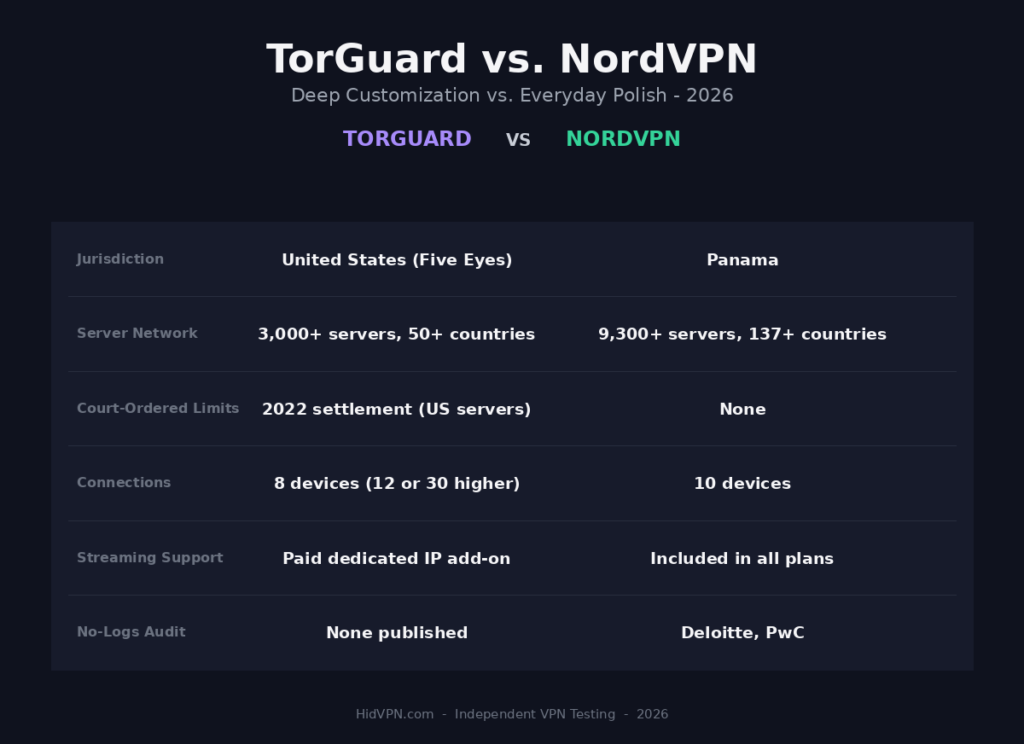
TorGuard vs. NordVPN is really a question about who you are. TorGuard is a US-based provider built for people who like opening the settings panel and staying there — manual port selection, cipher toggles, custom scripts, protocols most consumers have never heard of. NordVPN is the polished Panama-based option that most people install, click once, and forget about.
Both are legitimate. But TorGuard has picked up some real operational baggage over the past few years — a 2022 legal settlement that permanently changed what its US servers will carry, and a pricing model where the headline number isn’t the number most people end up paying. We put both through the same checks on price, network restrictions, jurisdiction, customization, and speed. Here’s where each one lands. You can also see how they stack up against everything else we’ve tested on our VPN comparison page.
Table of Contents
- Head-to-Head Specification Sheet
- Round 1: Pricing and the Dedicated IP Add-On
- Round 2: Network Restrictions and the 2022 Settlement
- Round 3: Jurisdiction, Corporate Structure, and Trust
- Round 4: Customization, Protocols, and Speed
- Round 5: Stealth and Anti-Censorship Tools
- TorGuard vs. NordVPN: The Final Verdict
- Sources
Head-to-Head Specification Sheet
| Feature Category | TorGuard VPN | NordVPN |
|---|---|---|
| Parent Company / Jurisdiction | VPNetworks LLC / United States (Five Eyes) | Nord Security / Panama |
| Server Network | 3,000+ servers in 50+ countries | 9,300+ servers in 137+ countries |
| Court-Ordered Network Limits | 2022 settlement restricts traffic on all US servers | None |
| Default Protocol | WireGuard, OpenVPN, OpenConnect | NordLynx (WireGuard-based) |
| Simultaneous Connections | 8 devices (12 or 30 on higher tiers) | 10 devices |
| Streaming Support | Requires a paid dedicated IP add-on | Included natively in all plans |
| Independent No-Logs Audit | None published | Deloitte, PwC |
| App Style | Technical, toggle-heavy dashboard | Polished, map-based |
| Starting Price (Long-Term) | ~$4.27–$4.30/month (annual) | ~$3.49/month (2-year) |
Round 1: Pricing and the Dedicated IP Add-On
TorGuard’s Real Cost
TorGuard’s annual plan runs about $4.27 to $4.30 a month, or $9.99 month-to-month. On paper that’s competitive. The complication is what the standard plan does and doesn’t cover.
TorGuard’s shared server IPs are widely recycled, and major streaming platforms detect and block them — so if watching content while connected is part of why you want a VPN, the base plan often won’t do it. TorGuard’s own answer is a dedicated streaming IP add-on, which runs an extra $7.99 to $12.09 per month. It’s an effective product: a dedicated IP isn’t shared with thousands of other subscribers, so it doesn’t carry the same detection baggage. But it roughly triples your real monthly cost, pushing the total into the $12 to $16 range.
NordVPN’s Flat Pricing
NordVPN starts at $3.49 a month on a 2-year term with no equivalent tiering. Its SmartPlay routing is built into every plan and every server, so streaming compatibility isn’t a paid extra — it’s just part of the product. Nord also offers a dedicated IP for people who specifically want a static address, but it’s an option rather than a prerequisite.
- Round 1 Winner: NordVPN. It’s cheaper at the headline price and dramatically cheaper once you account for what TorGuard charges to make streaming work.
Round 2: Network Restrictions and the 2022 Settlement
What Happened to TorGuard’s US Servers
This is the single most important thing to understand about TorGuard in 2026, and it’s easy to miss on their marketing pages.
In 2022, TorGuard settled a lawsuit brought by 27 independent film studios. As part of that settlement, TorGuard agreed to block certain file-sharing protocols on every server it operates inside the United States. That restriction is enforced at the network level by TorGuard’s own firewalls — it isn’t a policy you can opt out of or a setting you can toggle.
The practical consequence is a performance one. Any workload that depends on those protocols — Linux distribution mirrors, game patch delivery, blockchain sync clients — has to route through an international server instead of a nearby US one. For North American users that means noticeably higher latency and slower throughput on exactly the traffic type TorGuard originally built its name and its brand around.
NordVPN’s Network
NordVPN is Panama-based and hasn’t been party to comparable US litigation, so its network carries no equivalent service-level restrictions. Every server behaves the same way regardless of which country you connect through, which means you’re picking a server based on distance and load rather than on what that particular location is permitted to carry.
- Round 2 Winner: NordVPN. Not because of any specific use case, but because a network with uniform behaviour across all locations is simply more predictable than one where an entire country’s servers operate under a court-ordered exception.
Round 3: Jurisdiction, Corporate Structure, and Trust
TorGuard: Orlando, Florida
TorGuard is operated by VPNetworks LLC and openly registered in Orlando, Florida. The transparency is commendable — plenty of VPN companies obscure their corporate ownership behind shell structures, and TorGuard doesn’t.
The location itself is the problem. A US-registered company sits inside the Five Eyes intelligence-sharing arrangement and is reachable by National Security Letters and sealed court orders. A no-logs policy is a promise about what a company chooses to record; it isn’t a shield against a legal instrument compelling it to start recording for a named user. And TorGuard, unlike most of its serious competitors, has still not published an independent third-party audit of its no-logs infrastructure. You’re asked to take the policy on faith.
NordVPN: Panama
NordVPN is registered in Panama, outside the Five Eyes framework and without mandatory data-retention law. Its no-logs claims have been audited repeatedly by Deloitte and PwC, and its entire server fleet runs on diskless RAM-only hardware — every reboot wipes the machine by design, so there’s no persistent storage to seize in the first place. You can read the full breakdown in our NordVPN review.
- Round 3 Winner: NordVPN. Better jurisdiction, verified audits, and hardware that structurally can’t retain what it doesn’t write to disk. This one isn’t close.
Round 4: Customization, Protocols, and Speed
Where TorGuard Wins
If you enjoy configuring things, TorGuard’s client is the more interesting piece of software by a wide margin.
- Protocol range. WireGuard, OpenVPN, OpenConnect, PPTP, L2TP, IPsec, and SSTP. OpenConnect in particular is built for enterprise networks and restrictive corporate firewalls, and almost no consumer VPN bothers to support it.
- Manual port and cipher control. You pick your connection port and your encryption level yourself — AES-GCM-128 for speed, AES-256-CBC for maximum strength — instead of accepting whatever the app decides.
- Connection scripts. You can trigger custom scripts on connect and disconnect, so specific applications close automatically the moment the tunnel drops.
NordVPN gives you none of that. Its app is a map, a button, and a short list of toggles, which is exactly right for most people and mildly frustrating for the rest.
Raw Speed
Configurability doesn’t translate into throughput. NordVPN’s NordLynx protocol rates among the fastest in independent speed testing on local connections, while TorGuard’s WireGuard and OpenVPN setups generally sit a step behind under load. That gap is small in absolute terms but consistent, and NordVPN’s much larger fleet means less crowding on any individual server.
- Round 4 Winner: Tie. NordVPN is faster and steadier. TorGuard gives you control nothing else in this price bracket offers. Which one matters more depends on whether you’d ever use those toggles.
Round 5: Stealth and Anti-Censorship Tools
Both providers can disguise VPN traffic to get a connection through aggressive network filtering — the kind used by state-level firewalls in China, the UAE, and Russia, or by restrictive corporate and campus networks. They just go about it differently.
TorGuard builds Stealth Proxy and V2Ray directly into the protocol list. These scramble the OpenVPN handshake so the traffic reads as ordinary HTTPS to deep packet inspection, and combined with OpenConnect support, TorGuard hands you several independent ways to get a connection through a hostile network.
NordVPN’s obfuscation works well, but it lives on a dedicated subset of servers rather than being available everywhere. You switch to obfuscated mode and pick from that smaller pool, which is simpler to use and less flexible when one particular approach isn’t working.
- Round 5 Winner: TorGuard. Multiple built-in stealth methods and OpenConnect make it the more adaptable tool when you’re up against serious network-level filtering.
TorGuard vs. NordVPN: The Final Verdict
Choose TorGuard if:
- You want manual control over ports, ciphers, and protocols, and you’ll use it.
- You need enterprise-grade protocols like OpenConnect to get through a corporate or campus firewall.
- You’re working against heavy state-level filtering and want several independent stealth options rather than one.
- You want connection-triggered scripts to automate what happens when the tunnel drops.
Choose NordVPN if:
- You want streaming compatibility included rather than sold as a monthly add-on.
- You care about verified privacy — Panama jurisdiction, Deloitte audits, RAM-only servers.
- You want the faster, more consistent connection and a far larger server fleet to spread across.
- You’d rather the app just worked than spend an evening tuning it.
TorGuard is still a serious piece of engineering, and for a specific kind of technical user it does things nothing else at this price does. But the US jurisdiction, the absent no-logs audit, the court-ordered restrictions on its entire US server fleet, and the add-on you need to buy before streaming works reliably all stack up. For most people, NordVPN is the better buy — and it’s cheaper.