
HidVPN earns a commission if you buy through some of the links on this page. PureVPN is one of those. It did not win this comparison. Our affiliate disclosure.
Which one wins
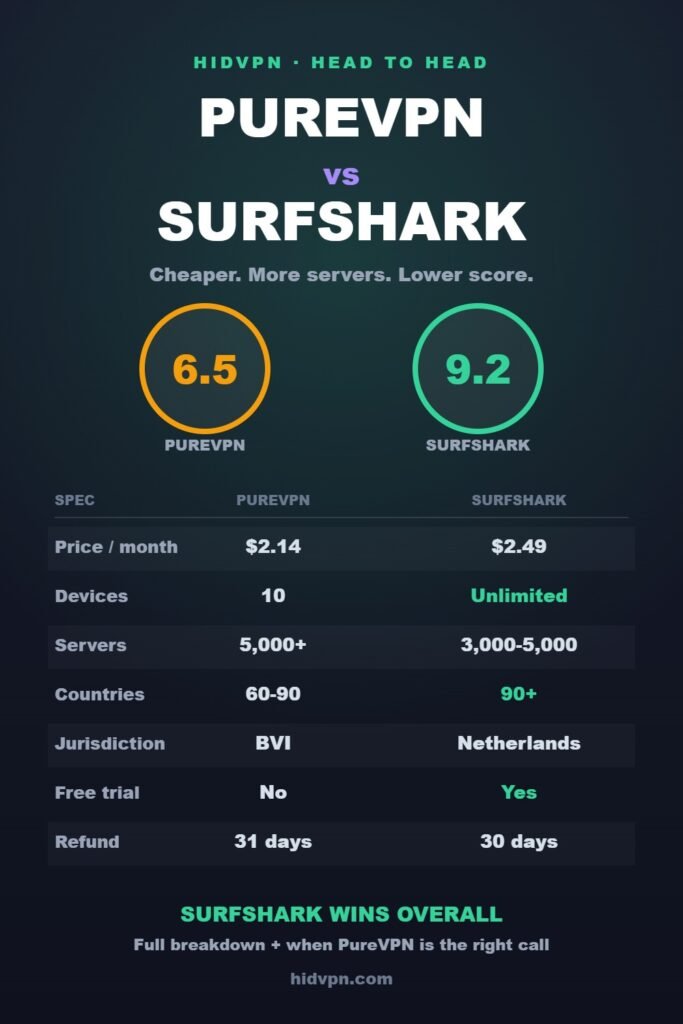
Surfshark, and it isn’t close on our scoring — 9.2 against PureVPN’s 6.5.
What makes this comparison worth reading is why. PureVPN is cheaper. PureVPN has more servers. PureVPN supports more protocols and has a longer refund window. On a spec sheet it looks like the better buy, and plenty of comparison pages will tell you so. The gap in the scores comes from something a spec sheet doesn’t show.
The biggest difference: a past versus a jurisdiction
Both providers carry a privacy asterisk. They are completely different kinds of asterisk, and which one bothers you should decide this for you.
PureVPN’s is historical. The company handed over user records in a criminal case years ago, at a point when it advertised a no-logs policy. It has since restructured, moved to the British Virgin Islands, and submitted to repeated independent audits — including an always-on arrangement where an auditor can inspect at any time, not just on a scheduled date. That is a genuinely strong response. It does not un-happen the original incident.
Surfshark’s is structural and current. It is based in the Netherlands, a Nine Eyes member. Its no-logs policy has been independently audited and nothing has surfaced against it. But jurisdiction is not a thing a company can audit away — it is where the company can be compelled, today, by a government that shares intelligence with others.
So the real question is which you trust less: a company that behaved badly and rebuilt, or a company that has behaved well from an address you would rather it didn’t have.
Price
PureVPN is cheaper, but not by much.
- PureVPN: $2.14/month on its longest plan
- Surfshark: $2.49/month on its longest plan
Thirty-five cents a month is about four dollars a year. Set against a 2.7-point scoring gap, price is the weakest reason to pick between these two.
Two things matter more than the headline number. Surfshark offers a free trial; PureVPN does not. And the refund windows are near-identical — 31 days for PureVPN, 30 for Surfshark — so both give you a real month to decide either way. The trial is the meaningful difference: it lets you test before any money moves.
One warning that applies to both, and to every VPN sold this way: these prices are first-term only. Renewal is substantially higher.
The mechanism is worth understanding because it shapes every price you will see compared anywhere. The advertised monthly figure is the total cost of a two- or three-year commitment divided by the number of months in it, charged as one payment up front. You are not paying $2.14 a month — you are paying somewhere north of $75 today. When that term ends, the subscription renews at the standard rate, which is typically two to four times the introductory equivalent, and it renews automatically unless you intervene.
That makes the headline gap between these two even less meaningful than it looks. A thirty-five cent difference on a promotional rate tells you nothing about what the two providers cost in year three. Before you buy either, find the renewal price on the checkout page — not the marketing page — and decide based on that number instead.
Speed
Both run WireGuard as their fastest protocol, which means the underlying performance ceiling is similar. Modern WireGuard implementations on decent hardware are close enough that protocol choice is not the deciding factor.
Where they separate is consistency. Our rating records Surfshark’s connection stability as excellent and PureVPN’s as good. Both are usable ratings. The distinction is not peak speed on a good server — it is how often you hit a bad one. PureVPN’s own published limitations acknowledge that performance is not uniform across its network, and with 5,000+ servers spread across 60–90 countries, that variance has more places to hide.
It helps to be precise about what stability means, because it is not the same thing as speed. A fast, unstable connection delivers high throughput most of the time and drops or stalls occasionally. A slower, stable one delivers less peak speed and holds it. For downloading a large file, peak speed wins. For a video call, a live stream, or anything where a two-second interruption is noticeable, stability matters more — and it is the thing people actually complain about.
What we did not do: we have not run first-hand speed tests on either provider. Our speed and stability figures come from published specifications and independent benchmark reports, cross-checked against each other. Where we have done hands-on testing, we say so on the page — and we haven’t here. Our testing methodology sets out exactly what we evaluate and how it is weighted.
Privacy and jurisdiction
Specs first, then what they mean.
Both hold audited no-logs policies. Both run a kill switch and split tunneling. Surfshark adds MultiHop (routing through two servers), rotating IP, and GPS spoofing on mobile. PureVPN adds port forwarding, which Surfshark does not offer.
PureVPN supports five protocols — WireGuard, OpenVPN, IKEv2, IPSec and L2TP — against Surfshark’s three. That sounds like an advantage and mostly isn’t. L2TP and IPSec are legacy options you should not be choosing in 2026. A shorter protocol list that drops the obsolete entries is a defensible product decision, not a missing feature.
On jurisdiction: BVI has no data-retention laws and no intelligence-sharing treaty obligations, which is why privacy-focused companies register there. The Netherlands has both. If jurisdiction is the top line of your threat model, PureVPN’s address is better than Surfshark’s — and that is the single strongest argument anyone can make for PureVPN here.
What a no-logs audit actually proves
Both providers advertise an audited no-logs policy, and the phrase does less work than it appears to. An audit is a third-party firm examining server configuration, internal policy and data handling at a point in time, then publishing an opinion. It is a snapshot, not a guarantee, and it cannot tell you what the company will do next year or under legal pressure it has not yet faced.
That is why PureVPN’s always-on arrangement is a real distinction rather than marketing. An auditor able to inspect at any moment, without a scheduled date to prepare for, is a meaningfully stronger commitment than an annual review. Whether it outweighs the original incident is a judgement call, and one you should make yourself rather than take from a comparison table. We’ve written a plain-English guide to what no-logs claims cover if you want the detail before deciding.
Streaming
Both list streaming support, and for the thing most people actually care about — whether video plays smoothly at the quality you pay for — the deciding factor is speed consistency, not server count.
That favours Surfshark on our ratings. PureVPN’s documented limitations include inconsistent performance across regions, which on a video stream shows up as buffering or a quality drop rather than an outright failure.
We don’t publish claims about which services a VPN can or cannot access. That changes constantly, it varies by server and by week, and any page stating it as settled fact is telling you something it cannot know.
Gaming
PureVPN lists gaming as a supported use case; Surfshark lists censorship circumvention instead. Take both with some salt — these are marketing categories, not measurements.
For gaming the number that matters is latency, and latency is mostly a function of physical distance to the server plus how congested it is. Neither provider publishes per-server latency. PureVPN’s larger raw server count is a mild theoretical advantage if one happens to sit near you; Surfshark’s better stability rating is a mild advantage against mid-match disconnects. Neither is strong enough to decide on.
If gaming is your primary reason for buying a VPN, neither of these is the obvious pick, and you should be comparing on nearest-server location rather than brand.
Device support
This is the cleanest win in the whole comparison, and it is Surfshark’s.
Surfshark allows unlimited simultaneous connections. PureVPN allows 10.
Ten is generous by industry standards and enough for most individuals. Unlimited changes what the product is for. A household of four with phones, laptops, a couple of tablets, a smart TV and a console passes ten quickly. At that point Surfshark stops being a personal VPN and becomes a household one at the same price.
Platform coverage is near-identical otherwise — Windows, macOS, Linux, iOS, Android, and router support on both. PureVPN lists one additional platform in our database, but on the platforms that matter to most people there is nothing to choose between them.
There is a way around PureVPN’s limit worth knowing about. Installing a VPN on your router covers every device behind it while consuming a single connection slot, which turns 10 connections into effectively unlimited for anything on your home network. Both providers support this. The trade-offs are that router setup is more involved than installing an app, and you lose the ability to switch server location per device. If that appeals, our guide to running a VPN on your router covers the setup.
The caveat: this only helps at home. Phones and laptops that leave the house still need their own app and their own connection slot, and that is where a ten-device cap starts to bite for a family.
Which one fits your situation
The scores are a summary. Your circumstances aren’t.
- You’re covering a whole household. Surfshark, without hesitation. Unlimited connections against 10 is the difference between counting devices and not thinking about it.
- Jurisdiction is your first concern. PureVPN. BVI genuinely beats the Netherlands on paper, and if you weigh where a company can be compelled above what it did years ago, that’s a coherent position.
- You want to try before paying. Surfshark. It has a free trial; PureVPN doesn’t. Both refund inside a month, but only one lets you look first.
- You need port forwarding. PureVPN, by default — Surfshark doesn’t offer it. This is a narrow, technical requirement and you’ll know if it applies to you.
- You’re buying on price alone. PureVPN, and you’re saving about four dollars a year. Make sure that’s worth it to you, and check the renewal price on both before committing.
- You don’t have a strong opinion either way. Surfshark. It’s the higher-scoring product and the free trial makes the decision reversible.
Winner by category
| Category | Winner | Detail |
|---|---|---|
| Price | PureVPN | $2.14 vs $2.49/month — a narrow win |
| Simultaneous devices | Surfshark | Unlimited vs 10 |
| Jurisdiction | PureVPN | British Virgin Islands vs Netherlands (Nine Eyes) |
| Track record | Surfshark | No logging incident on record |
| Server count | PureVPN | 5,000+ vs 3,000–5,000 |
| Country coverage | Surfshark | 90+ vs 60–90 |
| Connection stability | Surfshark | Rated excellent vs good |
| Free trial | Surfshark | Available vs none |
| Refund window | PureVPN | 31 days vs 30 — a day in it |
| Extra privacy features | Surfshark | MultiHop, rotating IP, GPS spoofing |
| Port forwarding | PureVPN | Supported; Surfshark doesn’t offer it |
| Overall | Surfshark 9.2 | PureVPN 6.5 |
Which should you buy
Surfshark, for most people. It scores higher, it’s more consistent, it lets you try it first, and the unlimited-device policy quietly solves a problem you’d otherwise have to manage. The extra thirty-five cents a month is not a real obstacle.
Buy PureVPN if jurisdiction is the thing you care about most, and you’ve read about the logging incident and formed your own view that the restructure and the ongoing audits answer it. That’s a defensible decision made on the facts, not a mistake.
What we would not tell you is that PureVPN is the better product because it costs less. On our scoring it isn’t, and it earns us a commission — which is exactly why we’re saying so plainly.
If neither of these is quite right, our VPN filter tool narrows all 17 providers we track down to a shortlist based on what you actually need — price ceiling, device count, jurisdiction and the rest — in about a minute. You can also read the full PureVPN review and Surfshark review for the detail behind these scores.
Prices and specifications on this page were checked against each provider’s published information on 14 September 2026. VPN pricing changes often; verify before you buy.