
HidVPN earns a commission if you buy through some of the links on this page. It doesn’t change what we write. Our affiliate disclosure.
Table of Contents
Key Takeaways
- Some free VPNs are safe to use, but many aren’t. The difference is usually the business model: a free tier paid for by paying customers is a different thing from an app paid for by ads or data.
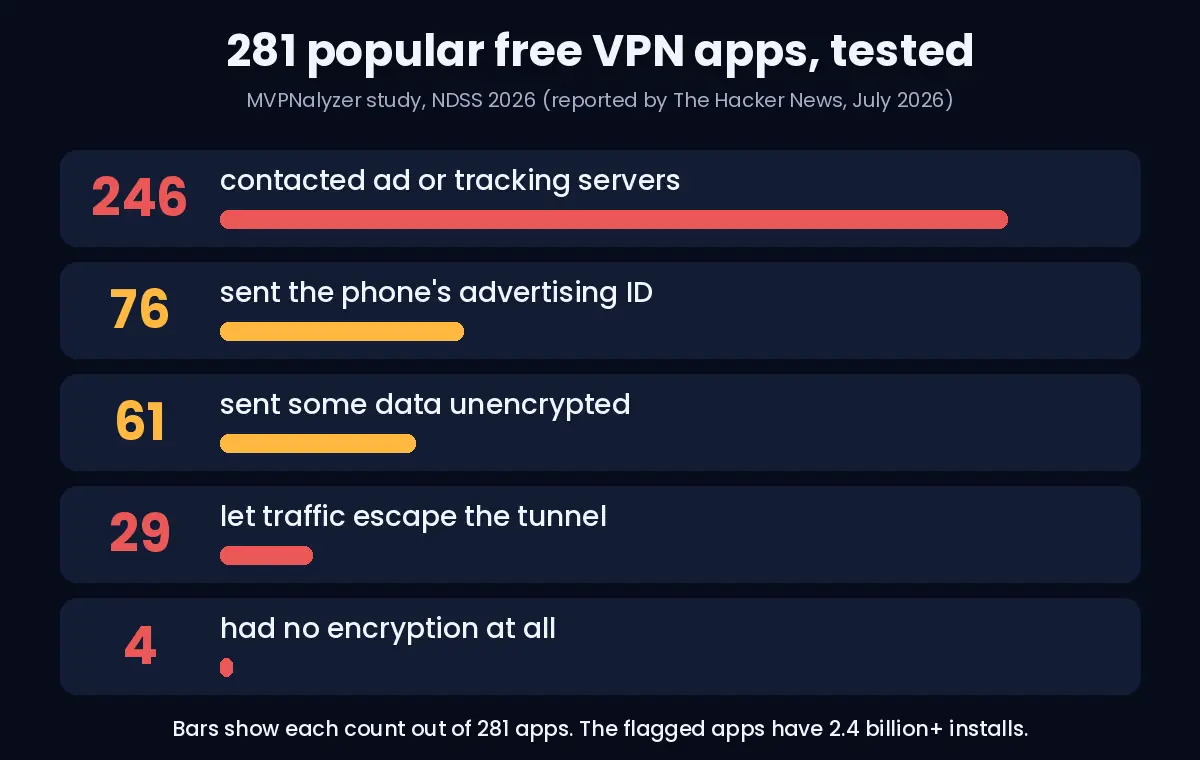
- A 2026 study of 281 popular free Android VPN apps found 29 that let traffic escape the tunnel, four with no encryption at all, and 246 that contacted advertising or tracking servers.
- Research published in October 2025 found apps from 21 seemingly separate providers that trace back to a few hidden owners, with passwords built into the apps and shared by every user.
- In our own tests from Sydney, Proton VPN Free and Hotspot Shield’s free Basic plan both hid our IP address and leaked nothing to our internet provider. Their limits are servers and speed, not safety on the network.
- Before trusting any free VPN: check who really owns it, read what the privacy policy says it collects, and run a leak test yourself.
The answer depends on how it pays for itself
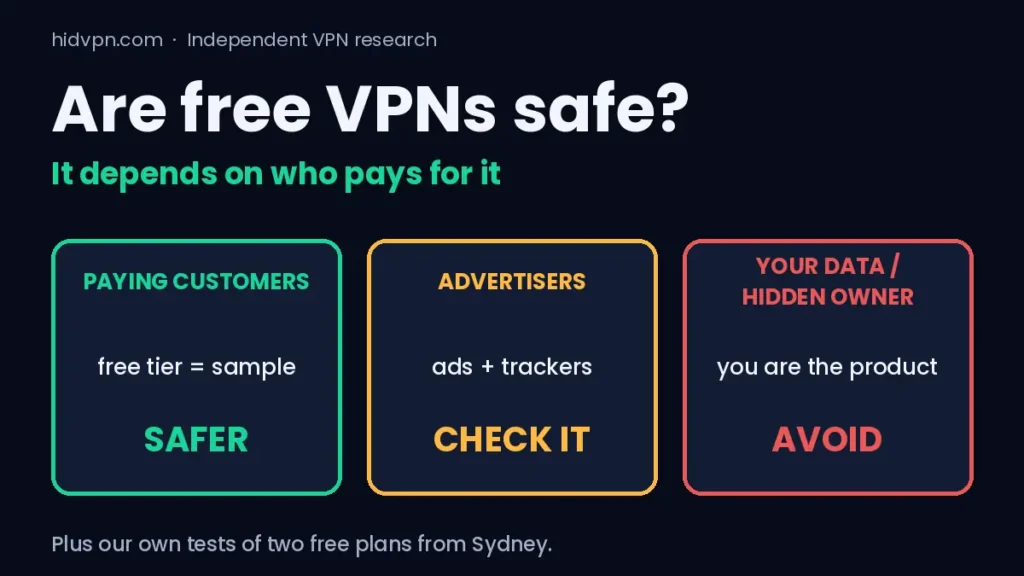
Running a VPN costs money: servers, bandwidth, staff. A free VPN still has those bills, so the useful question isn’t “is it free?” but “who pays?”. There are three common answers.
- Paying customers. The provider sells a paid plan and offers a limited free tier to win some of those customers. Proton VPN works this way. Your traffic isn’t the product; the upgrade is.
- Advertisers. The app shows ads, and often carries advertising and tracking code that reports on you to make those ads pay better.
- Your data, or someone you can’t see. The app collects information about you or your device and makes money from it, or it’s run by a company that hides who it is. These are the apps the research below keeps finding.
A VPN sees every site your device connects to, because it carries all your traffic. That’s why the “who pays” question matters more here than for, say, a free weather app. If the company behind the VPN makes money from data, it’s sitting in the best possible place to collect it.
What researchers found in free VPN apps
Three independent studies, spanning ten years, keep finding the same problems. All three looked at Android apps on Google Play, where most free VPN downloads happen.
2016: CSIRO and partners, 283 apps
Australia’s CSIRO, with UNSW and the International Computer Science Institute at Berkeley, tested 283 Android VPN apps. The paper found that 84% of the apps it analysed didn’t send IPv6 traffic through the tunnel, 66% didn’t send DNS lookups through it, and 18% used tunnelling without any encryption. The researchers also found apps that injected tracking and advertising code into the pages people visited.
2026: the MVPNalyzer study, 281 free apps
A decade later, researchers from the University of Michigan, the University of New Mexico and IIT Delhi built a tool called MVPNalyzer and ran it on 281 of the most popular free VPN apps on Google Play. They presented it at the NDSS security conference in February 2026. As reported by The Hacker News:
- 29 apps let traffic escape the encrypted tunnel. 24 of them leaked DNS lookups, the record of which sites you visit, across about 360 million installs.
- Six leaked full browsing traffic, and four had no encryption at all.
- 61 apps sent some data unencrypted. Five sent their configuration file in the clear, which would let someone on the network take over the connection.
- 246 apps, more than 80%, contacted known advertising or tracking servers. 76 sent the phone’s advertising ID, and one sent exact GPS coordinates.
- Of 108 apps whose OpenVPN settings could be checked, only one followed every best practice the researchers measured.
The apps they flagged have been installed more than 2.4 billion times.
2025: hidden owners behind “different” VPNs
In research summarised on the Internet Society’s Pulse blog in October 2025 (adapted from a report first published by the Open Technology Fund), security researcher Benjamin Mixon-Baca and two academic co-authors examined 32 popular VPN apps with over a billion downloads between them, from 21 providers that look unrelated. They traced them to two hidden clusters with more than 700 million downloads combined. Apps in both clusters shared code, used the same password built into the app for every user, which the researchers say would let anyone who obtained it decrypt traffic for all users, and collected location data while claiming not to. The researchers name TurboVPN, VPN Proxy Master and Snap VPN among the apps in the first cluster.
The pattern across all three studies is the same: the risk isn’t the word “free”, it’s an unknown company with a weak app and a reason to collect data.
What we found testing two free plans
We’ve tested two genuine free plans ourselves, on a Windows 11 laptop on a home connection in Sydney. These are the results from our reviews, with screenshots on each review page.
| Proton VPN Free | Hotspot Shield Basic (free) | |
|---|---|---|
| Tested | 9 October 2026 | 17 October 2026 |
| Sign-up | Account, no card | None, the app opened straight to Connect |
| Server | Picked by the app: Japan | Our choice of 5: Auto, Los Angeles, New York, Singapore, UK (no Australia) |
| Download, VPN off / on | 350 / 320 Mbps | 260–300 (two checks) / 260 Mbps |
| Latency, off / on | 5 / 114 ms | 6 / 324 ms |
| IP, DNS, WebRTC leaks | None; DNS answered by Proton in Tokyo | None to our provider; the DNS servers that answered were Google’s, in Singapore |
| IPv6 | Blocked while connected | Went through the VPN |
| Kill switch | Included on Free | Included, but off by default |
| Data cap | None (per Proton) | None seen in our test |
| Independent no-logs audit | Yes (Proton publishes them) | None published |
On the network, both did their job: our real IP address and our internet provider’s DNS servers disappeared once we connected. The differences are in control and trust. Proton’s free app chooses the server for you, and in our Windows test the ad blocker and split tunneling sat behind the paid plan. Hotspot Shield’s free plan lets you choose from five locations, but the nearest one to Sydney is Singapore, its kill switch was off until we turned it on, and the DNS servers that answered our lookups were Google’s rather than Hotspot Shield’s own. That isn’t a leak to our internet provider, which saw none of them, but it means a third company handled them.
The trust question is where they part ways. Proton VPN is based in Switzerland, its apps are open source, and its no-logs policy has been independently audited. Hotspot Shield is US-based, uses a closed-source protocol, and hasn’t published an independent no-logs audit. In August 2017 the Center for Democracy & Technology filed a complaint with the US Federal Trade Commission about the free app’s data collection and ad practices; AnchorFree, the owner at the time, disputed the claims. Full details are in our Proton VPN review and Hotspot Shield review.
We haven’t tested hide.me’s free plan yet, which is the third genuine free tier among the 17 providers we track. Our best free VPN page covers all three.
Free plan, free trial or free app: not the same thing
“Free VPN” covers three different offers, and they carry different risks.
- A free plan from a paid provider (Proton VPN, hide.me, Hotspot Shield). Limited, but run by a company you can identify, with a paid product that has to protect its reputation.
- A free trial or money-back window on a paid VPN. CyberGhost gave us a 24-hour free trial and Surfshark a 7-day trial for our tests; NordVPN has no free plan but offers 30 days to change your mind. These are paid products you try before committing, not free VPNs.
- A “free VPN” app from a developer you’ve never heard of. This is the group the studies above were mostly about.
If you want a VPN for a week of travel, a trial of a paid service is often a better choice than an unknown free app. If you want a VPN you never pay for, stick to the first group.
A five-minute check before you trust a free VPN
- Find the real owner. On the app store page, look at the developer name and address, then compare it with the company named on the VPN’s website and in its privacy policy. If they don’t match or you can’t find a real company, skip it.
- Read what the privacy policy says it collects. Look for words like “advertising ID”, “device identifiers”, “location” or “share with partners”. A VPN that says it doesn’t log browsing but collects all of those is still collecting a lot.
- Look for an independent audit. Few free apps have one. The free plans from providers whose paid service has been audited are a safer bet.
- Check the app’s permissions. A VPN needs network access. It doesn’t need your contacts, your precise location or your photos.
- Run a leak test. Connect, then open our IP leak test and check that your real IP address and your internet provider’s DNS servers are gone. Our guide on checking that your VPN is working walks through it in four steps.
Free VPN questions
Are there any good free VPNs?
A few. In our tests, Proton VPN Free hid our IP, leaked nothing and kept about 91% of our download speed on a Japan server, with no data cap. It’s the free plan we’d point people to first. Hotspot Shield’s free plan also passed our leak test but comes with more trust questions.
Which free VPN is the safest?
Of the ones we’ve tested, Proton VPN Free: an identifiable Swiss company, open-source apps and a published independent no-logs audit. The limits are that you can’t choose the server and some features need the paid plan.
Are free VPNs legal?
Using a VPN is legal in Australia and most other countries; what you do through it is covered by the same laws as without it. A few countries restrict VPNs. Our guide on whether using a VPN is legal covers the details.
Is Proton VPN free?
Proton VPN has a free plan with no data cap, one device and servers in a small set of countries chosen by the app. VPN Plus is the paid version.
Is NordVPN free?
No. NordVPN has no free plan; its cheapest option is US$3.49 a month on a 2-year term, and every plan has a 30-day money-back window. Our NordVPN cost breakdown has the full prices.
Can a free VPN steal my data?
A VPN app carries all your traffic, so a badly built or dishonest one is in a position to see which sites you visit and, on sites without HTTPS, what you send. The studies above found apps sending advertising IDs and location data and, in a few cases, no encryption. HTTPS still protects passwords and page contents on most sites, but the app still sees the names of the sites you visit (example.com, not the full page address) and any device identifiers it collects.
Sources
- Ikram et al., “An Analysis of the Privacy and Security Risks of Android VPN Permission-enabled Apps” (PDF), 2016.
- The Hacker News, “Study of 281 free Android VPN apps”, 10 July 2026 (MVPNalyzer, NDSS 2026).
- Center for Democracy & Technology, “CDT’s complaint to the FTC on Hotspot Shield VPN”, August 2017; eWeek, “FTC Asked to Investigate Hotspot Shield VPN Privacy Risks” (AnchorFree: the claims are “unfounded”).
- Internet Society Pulse, “Who owns, operates and develops your VPN matters”, 7 October 2025.
- HidVPN hands-on tests: Proton VPN Free, Sydney, 9 October 2026; Hotspot Shield Basic, Sydney, 17 October 2026.
Where to go from here
If you’re going to use a free VPN, use one from a company you can name, turn on its kill switch, and run a leak test the first time you connect. If your needs grow beyond a free plan’s limits, our budget VPN guide covers the cheapest paid options we’ve checked.