
NordVPN vs. Proton VPN is the comparison privacy-focused users end up at eventually. When privacy is the whole point, the list of providers worth trusting gets short fast — for a lot of people it ends up being NordVPN and Proton VPN.
Both have built real reputations on verified no-logs policies and a refusal to hand data to governments that come asking. But they get there from very different directions. NordVPN is the big, polished, commercial security suite — a VPN bundled with malware scanning, a password manager, and encrypted cloud storage, sold across neat subscription tiers. Proton VPN comes from the team behind Proton Mail and reads more like an activist tool: open-source, Swiss-based, built with journalists and dissidents in mind as much as everyday users.
The gap has narrowed lately. Proton quietly scaled its network past 20,000 servers in 145 countries[1][2] — bigger, on paper, than most of its competitors. NordVPN, meanwhile, folded real-time antivirus scanning straight into its apps.
Here’s how the two actually compare once you get past the marketing pages — jurisdiction, server counts, speed, and the security features that are genuinely different, not just re-skinned versions of the same thing.
Table of Contents
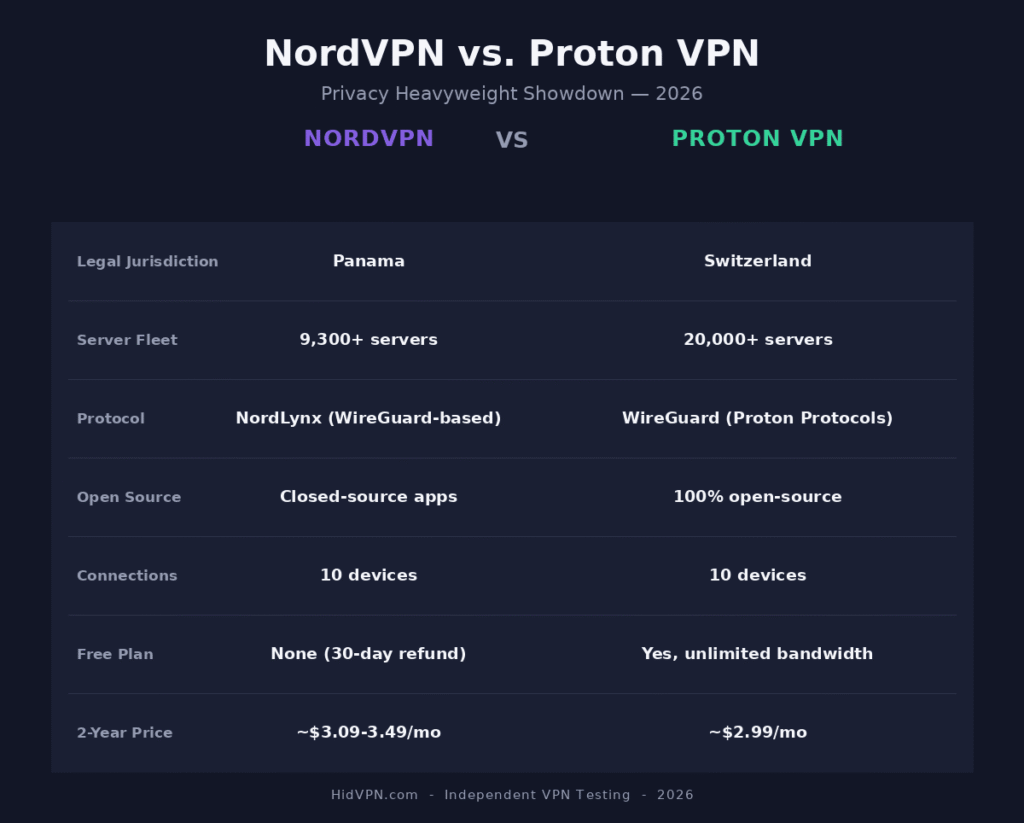
Head-to-Head Specification Sheet
| Feature Category | NordVPN | Proton VPN |
|---|---|---|
| Legal Jurisdiction | Panama | Switzerland |
| Server Fleet | 9,300+ servers in 137+ countries | 20,000+ servers in 145+ countries |
| Primary Connection Protocol | NordLynx (WireGuard-based) | WireGuard (upgraded Proton Protocols) |
| Open Source Credentials | Closed-source apps (audited regularly) | 100% open-source, publicly audited |
| Simultaneous Connections | 10 devices | 10 devices |
| Free Tier | 30-day money-back guarantee only | Forever-free plan, unlimited bandwidth |
| Starting Price (2-Year Plan) | ~$3.49/month | ~$2.99/month |
Round 1: Price, Tiers, and the Free-Plan Question
Both are competitively priced, but they structure things differently — and Proton’s free tier is the real wildcard here.
Proton VPN’s Subscription Options
Proton splits into three offerings:
- Proton Free: The only free VPN with no data cap and no ads. You’re limited to 10 server countries (US, Canada, Mexico, Netherlands, Switzerland, Norway, Romania, Poland, Japan, Singapore), 1 device, and P2P/streaming optimization is disabled. Still, “actually free, actually unlimited data” is rare enough that it’s worth mentioning on its own.
- VPN Plus: The full paid product — all 20,000+ servers, Secure Core multi-hop, the NetShield ad blocker, dedicated torrenting, top speeds. Around $2.99/month on a 2-year plan.
- Proton Unlimited: For $7.99 to $9.99/month depending on term, you get the VPN plus the top tiers of Proton Mail, Proton Pass, Proton Calendar, and Proton Drive (500 GB of storage). This is less “buy a VPN” and more “buy into an ecosystem.”
NordVPN’s Subscription Options
NordVPN’s tiers:
- Basic: Core VPN, 10 connections, NordLynx protocol. Starts at $3.49/month on a 2-year term.
- Plus: Adds NordPass and Threat Protection Pro (real-time malware scanning).
- Complete: Adds 1 TB of encrypted storage (NordLocker) and breach scanning.
- Round 1 Winner: Proton VPN. Its paid Plus plan undercuts NordVPN’s Basic tier slightly, and the free plan — genuinely unlimited bandwidth, no ads — has no real equivalent on Nord’s side.
Round 2: Jurisdiction, Audits, and Corporate Trust
A VPN’s legal home and how much of its code you can actually inspect are the two things that matter most here.
Switzerland vs. Panama
Proton VPN is headquartered in Geneva. Swiss privacy law is genuinely strict, and Switzerland sits outside both the EU and the Five/Nine/Fourteen Eyes alliances — authorities there can’t just demand logs without a Swiss court warrant. NordVPN is based in Panama, which has no mandatory data-retention law and is also outside the major surveillance alliances. Both are, structurally, about as good as it gets.
Open Source vs. Closed Source
This is where they really split. Proton VPN’s apps — Windows, macOS, iOS, Android, Linux, all of them — are 100% open-source, published on GitHub[3]. Anyone can go read the code and check how it actually handles your data, and Proton submits every build to independent security audits on top of that.
NordVPN’s apps are closed-source. It still gets audited regularly by firms like Deloitte and PwC, covering no-logs claims and server infrastructure, but the client software itself isn’t something you or anyone outside Nord can inspect line by line.
Bare-Metal vs. RAM-Only
NordVPN runs its 9,300+ servers diskless — everything lives in RAM, wiped the moment power is cut. Proton takes a different route: fully encrypted, bare-metal servers that Proton physically owns and controls down to the OS level, rather than leasing virtual instances from third-party cloud providers.
- Round 2 Winner: Proton VPN. Swiss jurisdiction plus fully open-source, independently audited apps is about as transparent as a VPN gets.
Round 3: Network Size, Speed, and Protocols
With both running enormous server fleets, this comes down to raw throughput and stability.
Proton VPN’s 20,000-Server Expansion
Proton’s network now sits past 20,000 servers in 145 countries[1][2] — one of the largest physical footprints in the industry, including specialized nodes in heavily censored regions like Kyrgyzstan, Gabon, and Cameroon[2]. It runs standard WireGuard as its backbone but layers on “Proton Protocols,” a rebuilt client-side implementation aimed at better speed and automatic conflict resolution. Its VPN Accelerator feature claims up to a 400% speed boost on long-distance international routes[3].
NordVPN’s NordLynx Edge
NordVPN runs fewer total servers but with exceptionally high density in major markets like the US and Western Europe. Its proprietary NordLynx protocol remains genuinely fast — it consistently rates among the quickest in independent speed testing, with low latency that holds up well for gaming and other high-bandwidth uses.
- Round 3 Winner: NordVPN. Proton’s network and Accelerator tech are impressive, but NordLynx still edges it out on raw download speed and latency under load.
Round 4: Security Features and Anti-Censorship Tools
Both go well past basic IP-masking with tools built for harder threat models.
Proton VPN’s Specialized Defenses
- Secure Core (Multi-Hop): Routes your traffic through hardened servers in privacy-friendly countries — including facilities in Switzerland, Iceland, and Sweden — before it exits through your target country, protecting against server seizure or state-level surveillance.
- NetShield: A DNS-level ad, tracker, and malware blocker.
- Stealth Protocol: Disguises VPN traffic as regular HTTPS to slip past firewalls like China’s.
- Port Forwarding: Useful if you’re maintaining ratios on private torrent trackers.
NordVPN’s Specialized Defenses
- Threat Protection Pro: Scans local downloads for malware, not just blocking ads.
- Double VPN: Nord’s take on multi-hop, encrypting traffic across two servers.
- Meshnet: Links your own devices together over an encrypted tunnel — handy for file sharing, remote access, or LAN gaming while traveling.
- Round 4 Winner: Tie. For anti-censorship and hard privacy, Proton’s Secure Core and Stealth protocol are better. For everyday utility, Nord’s Meshnet and malware scanning pull more weight.
Proton VPN’s audit record is its strongest card here. For what happens when a provider takes the opposite approach and collects no identity at all, see Proton VPN vs. Mullvad.
NordVPN vs. Proton VPN: The Final Verdict
Choose Proton VPN if:
- You want apps whose code you can actually go read.
- Swiss jurisdiction matters more to you than anything else.
- You want the bigger network — 20,000+ servers across 145 countries.
- You need serious anti-censorship tools like Secure Core.
- You torrent on private trackers and need port forwarding.
Choose NordVPN if:
- Raw speed is what you care about most.
- You want antivirus-style scanning built into the VPN itself.
- You want to link your own devices directly with Meshnet.
- You prefer a visual, map-based app.
If speed and an all-in-one suite are the priority, NordVPN is the easy pick. But if what you actually want is privacy you don’t have to take anyone’s word for — Swiss jurisdiction, fully open-source code, a genuinely enormous server footprint — Proton VPN wins this one.
Sources
- reddit.com
- tomsguide.com
- protonvpn.com
- ip-trackers.com
- vpnoverview.com
- gizmodo.com
- cybernews.com
- techradar.com
- security.org