
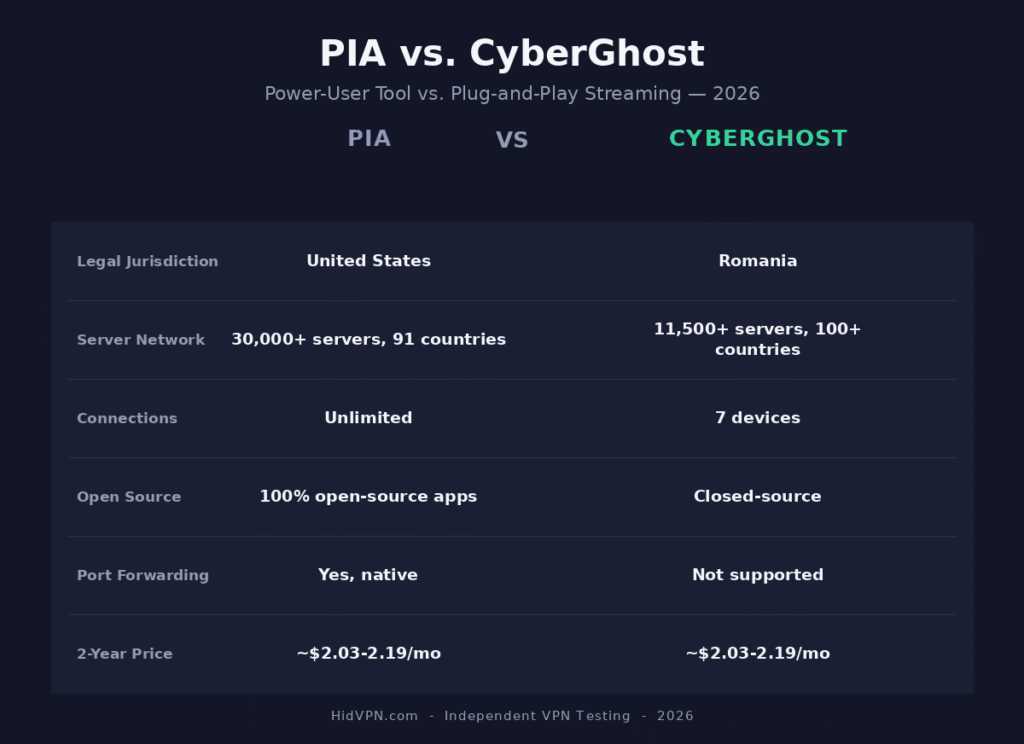
PIA vs. CyberGhost sounds like it should be a mismatch, but the two are siblings — both owned by the same parent company, Kape Technologies, which also owns ExpressVPN. See our full PIA review and CyberGhost review for more. Same corporate parent, completely different products. Different apps, different networks, different philosophies about who they’re building for.
PIA is the modular, open-source tool for people who want to get under the hood: manual encryption settings, port forwarding, DNS-level ad blocking, and no cap on how many devices you connect. CyberGhost goes the other way — it hides almost everything behind labeled, pre-configured profiles so you never have to think about which server to pick for a given task.
Here’s how the two stack up on speed, privacy, streaming, and day-to-day usability.
Table of Contents
Head-to-Head Specification Sheet
| Feature Category | Private Internet Access (PIA) | CyberGhost VPN |
|---|---|---|
| Legal Jurisdiction | United States | Romania |
| Server Network | 30,000+ servers, 91 countries | 11,500+ servers, 100+ countries |
| Simultaneous Connections | Unlimited | 7 devices |
| Open Source | 100% open-source apps | Closed-source |
| P2P Port Forwarding | Supported natively | Not supported |
| Ad Blocker | MACE (DNS sinkhole) | Standard ad-blocking filter |
| Starting Price (longest plan) | ~$1.79/month | ~$1.99/month |
Round 1: Pricing and Device Limits
Both land in the same price bracket, so the real differentiator is what you get for that money.
Private Internet Access Pricing
PIA runs $1.79/month on its 3-year plan (plus 3 extra months) — one of the cheaper options out there. The bigger deal is what’s not capped: unlimited simultaneous connections. One subscription covers every laptop, phone, tablet, and streaming box in the house without hitting a wall.
CyberGhost Pricing
CyberGhost matches PIA’s rate almost exactly, and backs it with a generous 45-day money-back guarantee (PIA’s is the standard 30 days). But it caps you at 7 simultaneous devices — plenty for most people, but you’ll notice it if you’re running a lot of hardware.
- Round 1 Winner: PIA. Slightly cheaper ($1.79 vs $1.99 a month), no device cap — that’s a meaningful edge for anyone with more than a handful of devices.
Round 2: Jurisdiction and Code Transparency
Where a VPN is legally based, and how much of its code you can check, shapes how much trust you’re extending on faith.
PIA’s US Jurisdiction — and Its Track Record
PIA is based in the US, a Five Eyes member, which sounds like a mark against it. But PIA has something most VPNs don’t: an actual courtroom track record. It’s been subpoenaed by US law enforcement more than once — 2016 and 2018 are the notable cases — complied with the warrants, and had no logs to hand over. That’s about as strong a real-world proof as a no-logs claim can get.
CyberGhost’s Romanian Base
CyberGhost is based in Bucharest, Romania, which sits outside the major surveillance alliances and has a history of striking down EU data-retention laws in its own courts. It also runs NoSpy servers — hardware in its own Romanian facility that it directly controls, rather than renting from a third-party datacenter.
Open Source vs. Closed Source
PIA’s apps are fully open-source across every platform — Windows, macOS, iOS, Android, Linux — published on GitHub for anyone to inspect. CyberGhost’s apps are closed-source, though its infrastructure and no-logs policy have been audited by Deloitte.
- Round 2 Winner: Tie. Romania’s jurisdiction is cleaner on paper, but PIA’s open-source code and actual subpoena history are hard to argue with.
Round 3: App Design and Everyday Use
This is really a question of how much control you want versus how much you want handled for you.
CyberGhost’s Profile-Based Design
CyberGhost’s app is built entirely around what you’re trying to do. There’s a Streaming tab with servers grouped by intended use and region — click one and it configures the routing for you. A Gaming tab sorts servers by live ping so you can pick the lowest-latency option without guessing.
PIA’s Modular Interface
PIA’s app is more of a toolbox. You can switch between AES-128 and AES-256 encryption depending on whether you want speed or maximum security, manually change handshake ports, and dig into settings CyberGhost just doesn’t expose.
- Round 3 Winner: CyberGhost. For anyone who doesn’t want to think about server selection, its profile-based design is just easier to live with day to day.
Round 4: Streaming, Torrenting, and Port Forwarding
Streaming Performance
CyberGhost groups servers into labelled profiles, which makes picking a location for video simple rather than guesswork. PIA has expanded from 13 to 35 locations it markets for streaming, and the routing has improved with it.
Beyond that, we are careful about what we claim. Which services work from which servers changes constantly — it varies by platform, by server and by week, and any page stating it as a fixed fact is describing a snapshot. We do not test playback against individual services, so we make no promises about it.
What determines video quality is sustained throughput and how close the server is to the content. On both counts these two are close enough that the deciding factor is usually which app you find easier to live with. Use the refund window to check your own services before committing.
Torrenting and Port Forwarding
This is where PIA pulls ahead for anyone serious about P2P. It’s one of the few budget VPNs left that still supports port forwarding — letting remote peers connect directly to your torrent client, which matters if you’re maintaining ratio on private trackers. CyberGhost has optimized P2P servers but no port forwarding.
- Round 4 Winner: Tie. CyberGhost for streaming and ease of use, PIA for torrenting and anyone who needs port forwarding.
PIA vs. CyberGhost: The Final Verdict
Choose PIA if:
- You want to cover an unlimited number of devices on one plan.
- You torrent seriously and need port forwarding.
- You want open-source apps you can inspect.
- You want DNS-level ad blocking via MACE.
Choose CyberGhost if:
- You want a simple, profile-based app that just works.
- Streaming is your main use case.
- You’d rather your VPN sit in Romania’s jurisdiction.
- You want a longer, 45-day refund window to test it.
CyberGhost is the easier sell for anyone who mostly wants to stream without thinking about it. But for power users, torrenters, or anyone covering a full household of devices, PIA — open-source, port forwarding, no device cap — is the better value.