
HidVPN earns a commission if you buy through some of the links on this page. It doesn’t change what we write. Our affiliate disclosure.
Key Takeaways
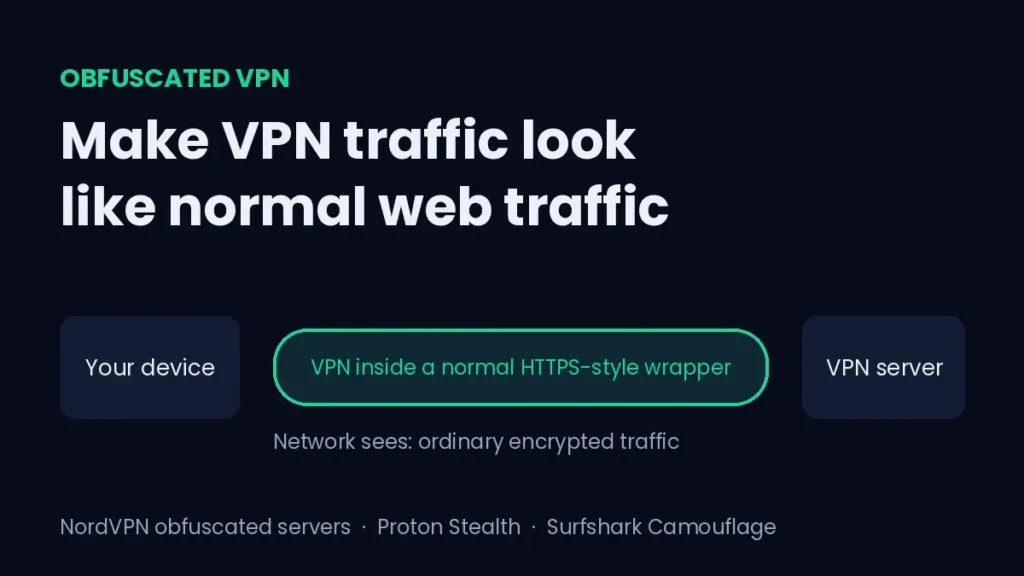
- An obfuscated VPN disguises VPN traffic so networks can’t easily recognise it, usually by making it look like ordinary web traffic. It’s for networks that block or slow VPNs: some countries, schools, workplaces and hotel Wi-Fi.
- It doesn’t make your data more secure. Your traffic is already encrypted by the VPN; obfuscation only tries to hide the fact that it’s a VPN.
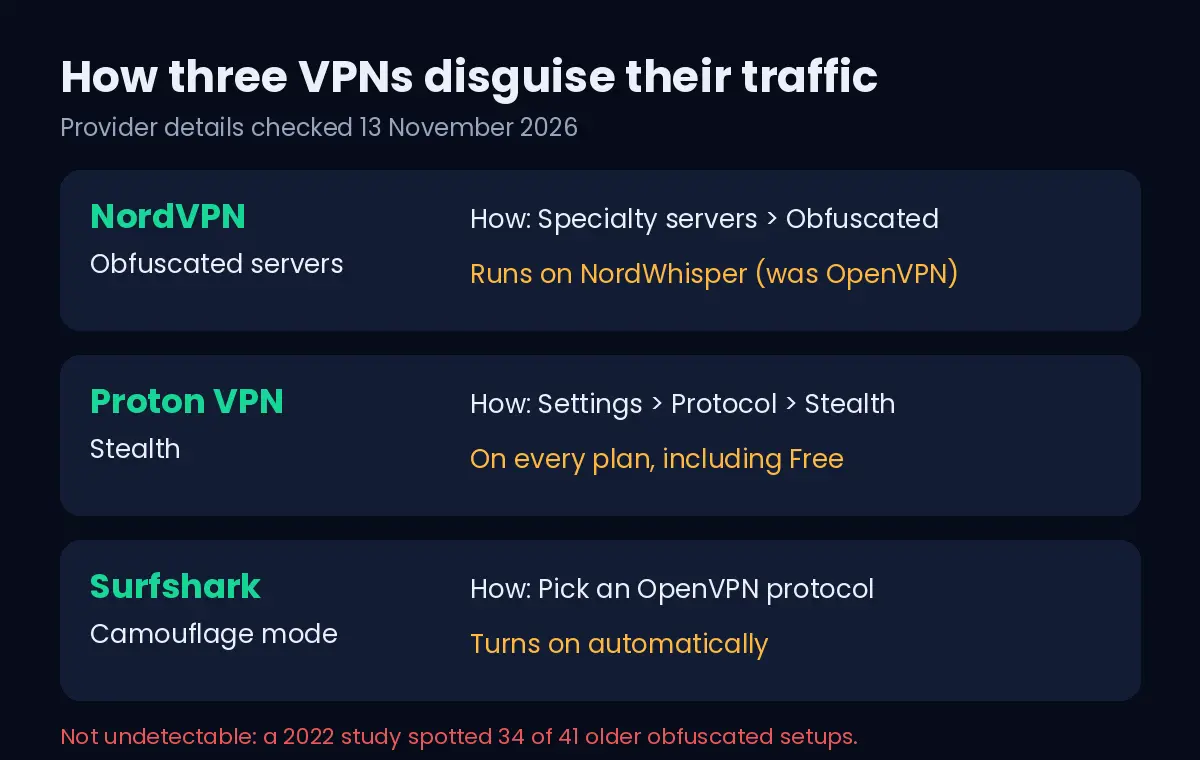
- NordVPN’s obfuscated servers now run on its own NordWhisper protocol instead of OpenVPN. Proton calls its version Stealth, and Surfshark’s Camouflage mode turns on by itself with OpenVPN.
- It isn’t invisible. Researchers working with a one-million-user internet provider identified 34 of 41 “obfuscated” VPN setups they tested in 2022 (older methods, before NordWhisper).
- On a normal home connection you don’t need it. Even NordVPN says its regular protocol is the better everyday pick on open networks.
Most networks don’t care that you use a VPN. Some do. A hotel, a school or a whole country can spot VPN traffic and block it, or slow it until it’s useless. An obfuscated VPN is the workaround: it wraps or scrambles the VPN connection so it’s harder to recognise, often by making it look like the encrypted web browsing everyone does all day.
How this guide was put together: we haven’t tested obfuscated servers on our own devices yet. Everything here comes from the providers’ own documentation, independent reporting and published research, all linked in the Sources section. When we run our own test from Sydney, we’ll add the results with the date.
How VPN obfuscation works
A normal VPN connection has a recognisable shape. The protocol has its own handshake, packet sizes and timing, and some protocols use their own network ports. A network that inspects traffic closely (this is called deep packet inspection) can learn those patterns and block anything that matches.
Obfuscation changes the shape. The common approaches:
- Wrap it in normal web encryption. The VPN traffic travels inside the same kind of encrypted connection (TLS) that every HTTPS site uses, usually on port 443. Proton describes its Stealth protocol as “obfuscated TLS tunneling over TCP”.
- Make it look like web browsing. NordVPN says NordWhisper uses web tunnel technology to make VPN traffic look like ordinary internet activity.
- Scramble the recognisable parts. Older methods modified OpenVPN traffic so its handshake didn’t match known patterns.
In every case, the data inside is still encrypted by the VPN as usual. Obfuscation is a disguise, not an extra lock.
Do you need an obfuscated VPN?
Probably not at home. You might if:
- Your VPN won’t connect on a particular network, such as hotel, airport, school or office Wi-Fi, while it works fine elsewhere.
- You’re travelling to a country that restricts VPNs. Freedom House reported in 2024 that Russia had blocked close to 200 VPN services and that countries including Iran, Turkey, Belarus and Myanmar block or restrict them. Our guide to VPN laws by country covers the details. Install and test the VPN before you leave: VPN sites and app downloads can be hard to reach once you’re there. Turn on the app’s kill switch too, so nothing slips out if the connection drops.
- Your internet provider or network slows VPN traffic but not normal browsing.
Before you switch, rule out the simpler causes. Our VPN disconnecting guide and slow VPN guide cover the usual suspects, and a hotel login page that won’t load is a different problem with its own fix.
How NordVPN, Proton VPN and Surfshark do it
| Provider | Name | How you turn it on | What it runs on |
|---|---|---|---|
| NordVPN | Obfuscated servers | Server list → Specialty servers → Obfuscated | NordWhisper (NordVPN’s own protocol); previously OpenVPN |
| Proton VPN | Stealth | Settings → Protocol → Stealth | Obfuscated TLS tunnel over TCP (Proton’s own protocol) |
| Surfshark | Camouflage mode | Automatic when you choose an OpenVPN protocol | OpenVPN |
Provider details from each company’s own pages and independent reporting, checked 13 November 2026. App menus change, so the exact labels can differ by device.
NordVPN obfuscated servers
NordVPN’s obfuscated servers used to require switching the app to OpenVPN. That has changed. NordVPN’s support pages now say the Obfuscated Servers category runs on NordWhisper instead of OpenVPN, and TechRadar reported in July 2026 that the switch started on iOS with Android, Windows and macOS to follow. On an updated app you don’t need to change protocol first:
- Open the NordVPN app.
- Go to Specialty servers and choose Obfuscated.
- To pick a country, use the three-dot menu next to it.
If Obfuscated is greyed out, your app may not have the update yet: update the app, or on an older version switch the protocol to OpenVPN in Settings first, as NordVPN’s older instructions said.
One side effect: NordVPN says obfuscated servers can no longer be reached with a manual OpenVPN setup, which matters if you configure a router yourself. NordVPN also says NordWhisper is meant for restrictive networks, and that NordLynx, its default protocol, remains the better everyday pick on open ones. Our NordVPN review has our own Sydney test results from the regular servers.
Proton VPN Stealth
Proton launched Stealth in October 2022 as its own censorship-resistant protocol. It’s available on every plan, including Proton VPN Free. Proton’s Stealth page lists it in the Android, Windows, macOS and iOS apps, with steps for the Linux app too; choose it under the protocol setting. Proton calls it “undetectable” but also says it bypasses “most” firewalls and VPN blocking methods, which is the more realistic claim. Our Proton VPN review covers the free plan we tested.
Surfshark Camouflage mode
Surfshark doesn’t have a separate obfuscation switch. Surfshark says its OpenVPN protocol applies obfuscation automatically, and TechRadar describes this as Camouflage mode, which works only with OpenVPN. Its Windows, macOS, Android and iOS apps also have a separate NoBorders setting for restricted networks; Surfshark says it turns on by itself when the app detects restrictions, and you can also switch it on under Settings > VPN settings. If a network blocks you, change the protocol to OpenVPN in the app’s settings; if one OpenVPN option (UDP or TCP) fails, try the other. Our Surfshark review has our October 2026 test.
What obfuscation can’t do
- It isn’t undetectable. In a 2022 study presented at USENIX Security, researchers working with an internet provider of about one million users identified over 85% of OpenVPN connections and 34 of 41 “obfuscated” VPN configurations they tested. Those were older obfuscation methods; newer protocols such as NordWhisper and Stealth may do better, but no provider has published independent proof that theirs can’t be spotted.
- It’s usually slower. Wrapping traffic in an extra layer (and often running it over TCP) adds overhead. That’s why providers suggest their normal protocol for everyday use.
- It doesn’t make you anonymous. Logins, cookies, leaks and the VPN company’s own records still matter. Our guide to whether a VPN can be tracked covers what identifies people even when the VPN works.
- It doesn’t change the law. Where VPNs are restricted, using one can still be an offence. Check before you travel.
Obfuscated VPN questions
What is an obfuscated VPN?
A VPN connection disguised so networks that block VPNs find it harder to recognise, often by making it look like ordinary encrypted web traffic.
Does NordVPN still need OpenVPN for obfuscated servers?
Not on updated apps. NordVPN says its Obfuscated Servers category now runs on its NordWhisper protocol, so you select Specialty servers → Obfuscated without changing protocol. If your app hasn’t updated yet, the older OpenVPN step may still apply.
Is Proton VPN Stealth free?
Yes. Proton says Stealth is available on all plans, including the free one.
Is an obfuscated VPN safer?
Not in terms of encryption. Your data is already encrypted by the VPN; obfuscation only tries to hide that you’re using one, and it can still be detected. On a network that punishes VPN use that disguise can matter, but it doesn’t make VPN use legal or invisible.
Should I leave obfuscation on all the time?
There’s little reason to on an open network. It’s usually slower, and NordVPN itself recommends its regular protocol for everyday use. Switch to it when a network blocks your VPN.
Is using an obfuscated VPN legal?
In most countries, including Australia, the US and the UK, using a VPN is legal (see our guide to VPN laws by country). In countries that restrict VPNs, disguising one doesn’t make it legal.
If you’re choosing a VPN for travel, see NordVPN’s current plans, or compare all 17 providers on our comparison table.
Sources
- NordVPN: Obfuscated Servers are getting an upgrade and How to connect to NordVPN’s obfuscated servers (read 13 November 2026).
- TechRadar: NordVPN brings its obfuscated servers to NordWhisper, 3 July 2026.
- Proton: Defeat censorship with Stealth, 6 October 2022, and TechRadar: Proton VPN rolls out obfuscated protocol.
- Surfshark: obfuscated servers (read 13 November 2026) and TechRadar: Surfshark Camouflage mode.
- Xue et al., “OpenVPN is Open to VPN Fingerprinting”, USENIX Security 2022.
- Freedom House: authoritarians expand restrictions on VPNs, November 2024.