
Quick Fixes First
ExpressVPN not working usually comes down to an outdated app configuration, an overloaded server location, protocol compatibility, DNS settings, or the eight-device ceiling. The quickest solution is to test the basics before changing advanced settings.
- Disconnect ExpressVPN and confirm that ordinary internet access works.
- Close the app, restart your device, and restart Wi-Fi or mobile data.
- Update ExpressVPN and your operating system.
- Try a nearby server rather than a distant location.
- Change Lightway to OpenVPN UDP, then OpenVPN TCP.
Lightway is ExpressVPN’s own default protocol. OpenVPN UDP and TCP are practical fallback options when the default tunnel conflicts with a router, firewall, or network. We researched the common failure points reported in and recommend changing one setting at a time; otherwise, you won’t know which adjustment solved the problem.
Connected But No Internet
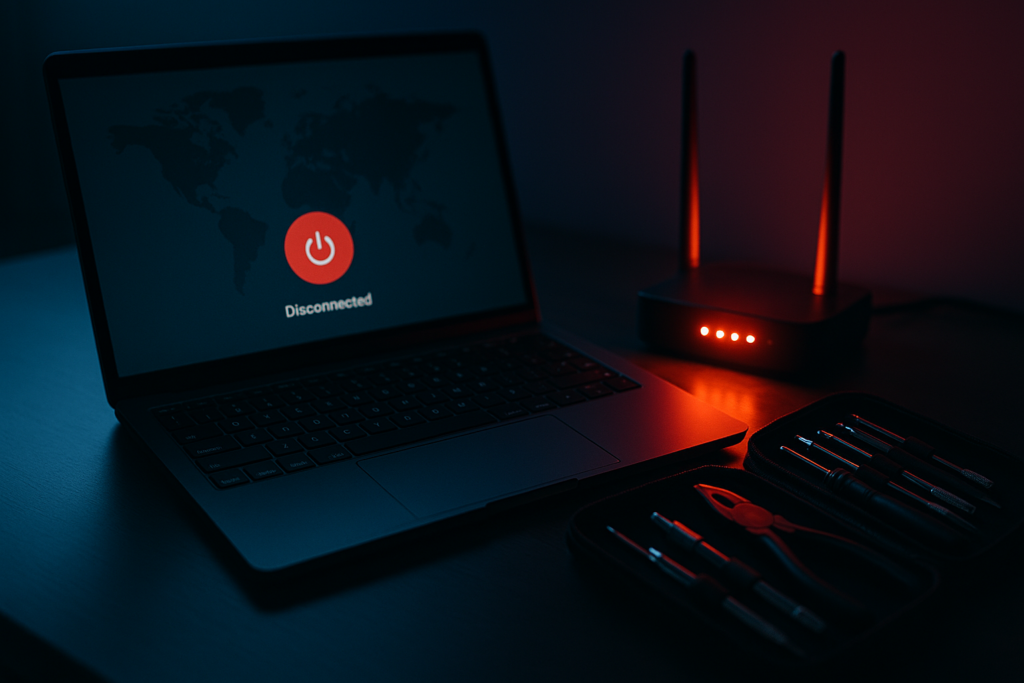
A VPN can report “connected” while encrypted DNS, routing, or Network Lock prevents traffic from passing. Network Lock is ExpressVPN’s name for its Internet Kill Switch, and it may stop all traffic when the tunnel is incomplete or unexpectedly drops.
- Disconnect ExpressVPN and test a normal website.
- Reconnect to a nearby server and wait seconds.
- Review Network Lock and local network access settings temporarily for diagnosis.
- Reconnect Wi-Fi or restart the network adapter.
- Test a second server before changing DNS manually.
Third-party firewall rules, router security settings, custom DNS, and ISP Throttling can interfere with the tunnel even when the app shows a successful connection. ExpressVPN’s encrypted DNS is designed to send DNS requests through the VPN, but security software or a custom DNS profile can redirect or block those requests.
After service returns, use an IP Address Checker, DNS Leak Test, and WebRTC Leak Test. A changed public IP generally indicates that routing is active; an unexpected DNS provider or exposed local address suggests a DNS, browser, or network configuration issue.
We found that restarting both the app and Wi-Fi solved more ordinary routing failures than repeated reinstalls. If the issue affects every server and two networks, preserve your settings and move to the support steps below.
Slow After Connecting
VPN speed depends on physical distance, server congestion, Wi-Fi interference, protocol overhead, background downloads, and ISP Throttling. A nearby server with ms latency can feel considerably more responsive than a distant server at ms, even when both show similar download speeds.
Run three tests without the VPN and three with it. Record download speed, upload speed, and latency for each result rather than trusting one unusually fast or slow reading. Repeat the comparison once during the day and once during the evening, when household and regional congestion may differ.
- Pause cloud backups, game downloads, and video uploads.
- Test a nearby ExpressVPN location.
- Compare Lightway with OpenVPN UDP.
- Use OpenVPN TCP only when reliability matters more than speed.
- Repeat the test on Ethernet or a different Wi-Fi band if available.
Threat management, the ad blocker, and parental controls add filtering work. Test each feature separately instead of disabling every protection layer. Our internal guide explains why VPN streaming speed can be slow.
NordVPN and Surfshark may perform differently because server selection, protocol implementation, and network conditions vary. Our NordVPN and ExpressVPN comparison is useful for comparing trade-offs, not for making absolute speed claims.
Keeps Disconnecting
ExpressVPN keeps disconnecting when Wi-Fi briefly drops, a phone moves between Wi-Fi and cellular data, a router uses old firmware, or the device enters sleep mode. Overloaded locations and protocol instability can create the same experience, especially on mobile networks with changing signal quality.
Switch from Lightway to OpenVPN UDP. If drops continue, test OpenVPN TCP; TCP can be slower because it performs additional delivery checks, but it may be more tolerant of packet loss. Also test a second router or mobile hotspot to separate a local network fault from an app problem.
- Disconnect ExpressVPN and confirm ordinary internet works.
- Reconnect and observe whether traffic stops immediately after a tunnel drop.
- Review Network Lock if the outage is visible as “no internet.”
- Update router firmware and disable aggressive sleep or battery restrictions.
- Compare Lightway, OpenVPN UDP, and OpenVPN TCP.
For example, a user watching video on a phone may see repeated drops while walking from home Wi-Fi to cellular data. The subscription remains valid; the network handoff interrupts the tunnel. A dedicated IP, where available through the relevant service configuration, may provide a more consistent endpoint, but it cannot repair a failing router, protocol, or local firewall.
Won't Connect to a Server
When ExpressVPN will not connect to any location, work through the checks in order rather than reinstalling immediately. Subscription issues, expired payment details, authentication errors, and the eight-simultaneous-connection ceiling are separate causes that can produce similar messages.
- Verify that the base internet connection works without the VPN.
- Sign out and sign back in.
- Check subscription status and payment details.
- Update the app.
- Try three nearby server locations.
- Change Lightway to OpenVPN UDP and then TCP.
Captive portals in hotels or cafés can require browser sign-in before a VPN tunnel will negotiate. Incorrect date-and-time settings can also interfere with certificates. Third-party firewalls, antivirus web shields, router security rules, and conflicting VPN adapters are additional suspects.
A failure affecting one location may be a server issue; a failure across several locations, devices, and networks may indicate a wider ExpressVPN service outage. Check the official status page and support communications before repeatedly deleting the app.
Before contacting support, record the exact error wording, timestamp, device model, operating system, protocol, and server location. In our experience, those five details shorten the process considerably because they show whether the problem is account-based, location-specific, or local.
Network Lock Not Working
Network Lock is ExpressVPN’s Internet Kill Switch. It is intended to stop internet traffic when the VPN connection unexpectedly drops, but behavior varies by operating system, app version, firewall configuration, and selected settings.
Test it without exposing sensitive activity: connect to ExpressVPN, note the connected state, disconnect the tunnel, and check whether a harmless test page stops loading before reconnecting. Restore Network Lock after testing; a temporary diagnostic change should not become a permanent reduction in protection.
Split Tunneling is available on desktop and can intentionally send selected apps outside the VPN. Those apps may continue working when the VPN disconnects, which can look like Network Lock has failed. Local network access, third-party firewall software, and apps that maintain their own network connections can create similar exceptions.
Review ExpressVPN’s documentation and CISA cybersecurity guidance when assessing broader data protection. If you use filtering features, this guide to choosing a VPN filter tool can help you distinguish DNS filtering, app filtering, and tunnel protection.
Not Working on Windows
On Windows, blocked VPN drivers, Windows Defender Firewall rules, conflicting virtual adapters, pending updates, and corrupted app files are frequent causes. If you’re asking why ExpressVPN is not connecting on Windows, prioritize driver, firewall, protocol, and account checks in that order.
- Restart Windows and install pending Windows Updates.
- Temporarily review, but don’t permanently disable, antivirus and firewall rules.
- Test Lightway, then OpenVPN UDP and OpenVPN TCP.
- Remove an obsolete VPN adapter only if you recognize it and no longer need it.
- Reinstall the current ExpressVPN app from the official source.
Threat management, ad blocker, and parental controls may inspect traffic or DNS requests. Create a narrowly scoped exception for the ExpressVPN application instead of turning off protection permanently. Windows can also retain firewall rules from an older app build after an update.
A representative case involved a Windows update followed by a connection error. The user could authenticate, but pages would not load because an old virtual adapter and firewall rule no longer matched the network profile. Removing the old adapter and reinstalling the current app restored normal routing.
Microsoft has supported Windows for decades, but individual driver behavior still depends on the device manufacturer and security software. Test on a second network before concluding that ExpressVPN itself is unavailable.
Not Working on iPhone/iPad
Start with iOS basics: confirm Wi-Fi or cellular data works, turn off Airplane Mode, update iOS and ExpressVPN, approve VPN permissions, and try another server location. Low Data Mode, Private Relay, restrictive DNS profiles, and rapid movement between Wi-Fi and mobile data can affect connection behavior.
- Test Safari without ExpressVPN.
- Disable Airplane Mode and confirm the active network.
- Update the app and iOS.
- Switch from Lightway to OpenVPN where available.
- Restart the device.
- Reinstall the app if the VPN profile appears corrupted.
Location-verification problems are separate from tunnel failure. Review iOS location settings and remember that some services use browser location signals rather than only your IP address. When appropriate, test the ExpressVPN browser extension on a computer to determine whether the issue is app-specific.
Confidential computing and wider data protection claims don’t mean every iOS app will accept a VPN connection. An app can reject a connection because of its own policy, account settings, or service outage even while the VPN tunnel is healthy.
Not Working on Android
Android manufacturers often add battery and background-data controls that interrupt VPN apps. Check battery optimization, background data, always-on VPN, Private DNS, permission prompts, and manufacturer-specific network controls before changing advanced ExpressVPN settings.
- Disable battery optimization for ExpressVPN.
- Permit background data and notifications.
- Test Wi-Fi and cellular data separately.
- Update the app and restart Android.
- Compare Lightway with OpenVPN UDP and TCP.
Android Private DNS can create confusing results when a custom DNS provider remains active alongside ExpressVPN’s encrypted DNS. After reconnecting, check an IP Address Checker and DNS Leak Test. Results can vary by browser, cached records, and network, so repeat a surprising result in a second browser.
Threat management, ad blocker, and parental controls add separate filtering layers. Test each one independently and document whether all apps fail or only one app. A single affected app points more strongly to app permissions, its own DNS handling, or a service-side problem than to a failed VPN tunnel.
Not Working on Fire TV
Fire TV failures commonly involve an outdated app build, weak Wi-Fi, an incorrect Amazon account installation, background app conflicts, or another device already using one of ExpressVPN’s eight simultaneous connections. Streaming apps may also reject a VPN connection independently of the Fire TV app.
- Restart Fire TV and the wireless router.
- Open Settings, force-stop ExpressVPN, and clear its cache.
- Update or reinstall ExpressVPN using the correct Amazon account.
- Test a nearby server.
- Try Lightway, then an available OpenVPN option.
Use these VPN setup steps for Fire TV and Firestick to check installation and permissions. If several household devices need the same network path, you can set up a VPN on a router; that changes the network path for every connected device, so it also affects phones, computers, consoles, and smart TVs.
For a Firestick troubleshooting case, clear the cache before reinstalling, verify Wi-Fi speed, and review signed-in devices. Don’t assume every streaming app will accept a VPN connection simply because ExpressVPN connects successfully.
A Streaming App Shows a Proxy Error
A proxy error means the streaming service detected an IP address, DNS result, or connection pattern it doesn’t accept. It doesn’t prove that ExpressVPN is completely offline. Netflix, YouTube TV, and BBC iPlayer may show different messages when their detection systems flag a VPN endpoint.
- Try a different ExpressVPN server location.
- Clear the streaming app’s cache and restart the device.
- Verify automatic date and time.
- Review MediaStreamer settings.
- Check the service’s own help center for outages or account-location issues.
MediaStreamer is ExpressVPN’s smart-DNS feature, and it does not encrypt traffic. Don’t treat it as equivalent to an active VPN tunnel. A stale app update, incorrect account location, or service-side outage can produce the same proxy message, so changing VPN settings repeatedly may not help.
Our notes on how streaming VPN performance is assessed explain why detection results vary by endpoint and service. These checks are for identifying connection and configuration problems, not for presenting a VPN as a way to disregard a streaming service’s rules.
Device Limit Reached
ExpressVPN permits up to eight simultaneous connections. Reaching that ceiling can cause a new device to fail authentication or connection, even when the subscription is active and the server is healthy.
- List every signed-in phone, computer, tablet, TV, router, and browser extension.
- Disconnect devices that are idle or no longer in use.
- Retry the new device.
- Check the subscription, payment status, and recent account changes.
- Sign out of unused devices instead of repeatedly reinstalling the app.
A VPN configured on a router may count differently from individual app sessions in practical household use, so review the router and every app carefully. A family with three phones, two laptops, a Fire TV, a tablet, and a browser extension can reach eight active sessions without realizing it.
If an unknown device appears, change the account password and contact support. That is an account-security issue, not an ordinary connection fault. Don’t share the new password in a support chat or send unnecessary payment information.
Stopped Working After an Update
App, operating-system, router, antivirus, and streaming-service updates can alter permissions, drivers, DNS behavior, or firewall rules. In 2026, treating an update as a configuration change—not merely a speed change—makes diagnosis faster.
- Restart the device and router.
- Review permissions and settings changed by the update.
- Update related network drivers.
- Switch Lightway to OpenVPN UDP, then TCP.
- Reinstall the current ExpressVPN build without deleting useful error logs.
- Retest on a second network.
One detailed scenario involved Windows and Android devices that connected after an update but could not load pages. On Windows, a prior firewall rule no longer matched the new network profile; on Android, Private DNS continued pointing to a custom provider. Correcting those settings restored traffic without changing the account.
Check official release notes and support notices before attempting a risky rollback. The NIST Privacy Framework is a useful reminder that updates should be evaluated as part of wider data protection, not only connection speed.
When to Contact Support
Contact ExpressVPN live chat when multiple networks and protocols fail, subscription details look wrong, Network Lock behaves unexpectedly, or you cannot reconcile the eight-device limit. Support can distinguish a server-location problem, account issue, service outage, and local configuration conflict more efficiently when your testing is documented.
Provide the exact error, operating system, app version, protocol, server location, time of failure, and results from an IP Address Checker, DNS Leak Test, and WebRTC Leak Test. Also include screenshots, sanitized logs, firewall details, router model, and whether the failure occurs with Lightway and both OpenVPN modes.
Don’t send passwords, full payment details, recovery codes, or unrelated personal data. The FTC privacy and security guidance explains why limiting shared information matters during support conversations.
We recommend writing a short timeline: “09:10 updated Windows; 09:15 Lightway connected but pages failed; 09:20 OpenVPN UDP produced the same result; 09:25 mobile hotspot worked.” That evidence is more useful than saying only that ExpressVPN is not working.
Key Takeaways
- Test ordinary internet first before changing VPN settings.
- Try another nearby server and compare Lightway with OpenVPN UDP and TCP.
- Check Network Lock, encrypted DNS, Split Tunneling, antivirus, and firewall rules.
- Remember the eight-simultaneous-connection ceiling, including household routers and extensions.
- Contact live chat with documented errors, timestamps, device details, and test results.
Lightway is the default protocol; OpenVPN UDP and TCP are fallbacks. Split Tunneling is available on desktop, while MediaStreamer is smart DNS and does not encrypt traffic.
This checklist resolves the common cases, but no checklist can account for every ISP, device, app, router, or service outage. In 2026, make one change at a time, record the result, and restore security features after testing. Start with the five-minute checklist, use the section for your device, then escalate with collected diagnostics.
Frequently Asked Questions
Why is ExpressVPN connected but there is no internet?
ExpressVPN may show as connected while Network Lock, encrypted DNS, a firewall rule, or a routing conflict blocks traffic. Disconnect and test ordinary internet access, reconnect to another nearby server, then check your public address with an IP Address Checker; a changed IP confirms the tunnel is active, while an unexpected DNS result points to a DNS or local security configuration problem.
Why does ExpressVPN keep disconnecting?
Repeated drops commonly come from unstable Wi-Fi, movement between Wi-Fi and cellular data, router firmware, sleep-mode behavior, or protocol instability. Test Lightway against OpenVPN UDP and OpenVPN TCP; TCP can be slower but may tolerate packet loss better on an unreliable connection.
Why is ExpressVPN slow after connecting?
A distant or congested server, higher latency, Wi-Fi interference, background downloads, or ISP Throttling can reduce VPN speed. Compare three tests without the VPN and three with it, then try a nearby location and record download, upload, and latency results at two different times.
Why is ExpressVPN not working with Netflix?
Netflix may display a proxy error when its detection systems identify a VPN endpoint, DNS result, or unusual connection pattern. You can try another ExpressVPN server, clear the app cache, restart your device, and review MediaStreamer settings, while also checking Netflix’s help center for service-side or account-location issues.
Why is ExpressVPN not working on Firestick?
On Firestick, restart the device, force-stop ExpressVPN, clear its cache, install current updates, and test a nearby server. Check whether another device is using one of the eight simultaneous connections and try Lightway or an available OpenVPN option; the VPN setup steps for Fire TV and Firestick can help you verify installation.
Why is ExpressVPN not connecting on Windows?
Windows connection failures often involve Windows Defender Firewall, antivirus threat management, an old virtual adapter, or corrupted VPN files. Restart Windows, test Lightway, then OpenVPN UDP and TCP, and reinstall the current ExpressVPN app from its official source if the problem remains.