
HidVPN earns a commission if you buy through some of the links on this page. It doesn’t change what we write. Our affiliate disclosure.
Table of Contents
- Why people look for a Surfshark alternative
- The alternatives side by side
- NordVPN: the all-rounder
- Proton VPN: free plan and Swiss privacy
- CyberGhost: cheapest of the ones we tested
- hide.me: a free plan with no data cap
- Mullvad: no email, flat price
- When staying with Surfshark makes more sense
- Switching without losing protection
- Surfshark alternative questions
- Sources
Key Takeaways
- The best Surfshark alternative depends on why you’re leaving: NordVPN for an all-round upgrade, Proton VPN for a free plan and Swiss privacy, CyberGhost for the lowest price of the ones we tested, hide.me for a free plan without a data cap, Mullvad for an account with no email.
- We tested Surfshark, NordVPN, Proton VPN, CyberGhost and hide.me ourselves from Sydney in October 2026. All five passed our IP, DNS and WebRTC leak checks on nearby servers.
- Surfshark’s biggest strength is unlimited devices. None of the alternatives here match it: the limits run from 5 (Mullvad) to 10 (NordVPN, Proton VPN, hide.me).
- Look at the renewal price, not only the first-term price. NordVPN, Proton VPN and CyberGhost publish theirs; hide.me renews at the same price; Surfshark’s pricing page doesn’t show an amount.
- Prices below were checked on 29 October 2026, during sale pricing, and re-checked on 8 November. Check the current price before you buy.
Surfshark is a good VPN. We tested it hands-on in Sydney in October and it passed every leak check we ran, with no speed loss we could measure on a local server, and Deloitte checked its no-logs policy in 2025. So most people searching for an alternative aren’t escaping a bad product. They want something specific Surfshark doesn’t give them: a free plan, a different jurisdiction, a lower renewal price, or settings that are safer out of the box.
This guide matches each of those reasons to the provider that fits it, using our own test results where we have them and each provider’s official pages for prices, device limits and audits.
Why people look for a Surfshark alternative
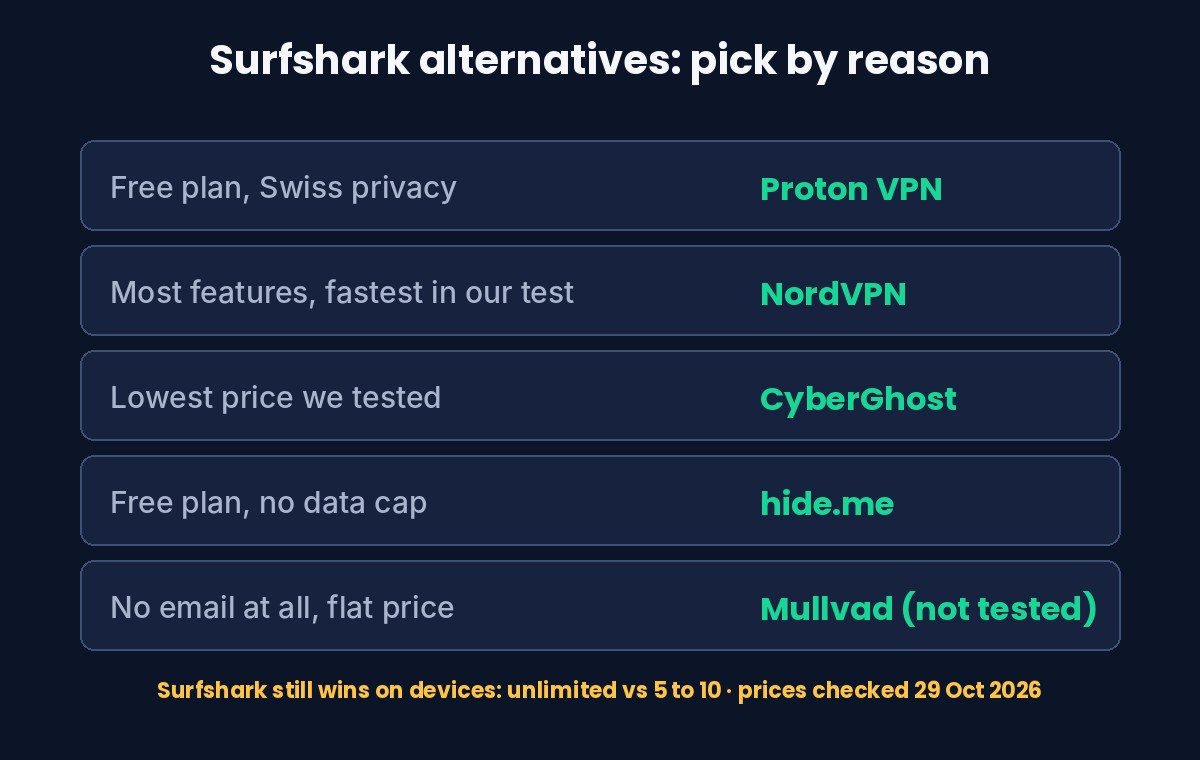
| If your reason is… | Look at | Why |
|---|---|---|
| “I want a free option” | Proton VPN or hide.me | Both have a permanent free plan; Surfshark has a trial only |
| “I want the most features and speed” | NordVPN | No speed loss we could measure on a Sydney server, 10 devices, six independent no-logs assessments |
| “I want the lowest price” | CyberGhost | Cheapest first term of the VPNs we tested, 7 devices |
| “I don’t trust renewals” | hide.me or Mullvad | hide.me renews at the same price; Mullvad charges one flat price every month |
| “I want a different jurisdiction” | Proton VPN (Switzerland) | Swiss company under Swiss law; Surfshark is run from the Netherlands |
| “I don’t want to give an email” | Mullvad | Account is a random number; no email, username or password |
| “I didn’t like the default settings” | CyberGhost or hide.me | Their kill switch was on by default in our tests; Surfshark’s was off |
Watch: the four alternatives in 30 seconds (HidVPN Short)
The alternatives side by side
Prices are each provider’s cheapest plan on its longest term, in US dollars, as shown on its pricing page on 29 October 2026 and re-checked on 8 November 2026 (CyberGhost’s longest plan had changed to 28 months; hide.me’s page couldn’t be re-read, so its price is from 29 October). “First term” is the full prepaid period including bonus months.
| VPN | Devices | Monthly price (longest term) | First term billed | Renewal | Free option | Based in |
|---|---|---|---|---|---|---|
| Surfshark (for comparison) | Unlimited | $2.49 (Starter) | $67.23 for 27 months | Not shown on pricing page | Free trial | Netherlands |
| NordVPN | 10 | $3.49 (Basic) | $94.23 for 27 months | $139.08 a year | None | Panama |
| Proton VPN | 10 (Free: 1) | $3.49 (VPN Plus) | $83.76 for 24 months | $83.88 a year | Free plan | Switzerland |
| CyberGhost | 7 | $2.19 | $61.32 for 28 months | $61.32 a year | 24-hour trial (Windows, Mac) | Romania |
| hide.me | 10 (Free: 1) | $2.50 | $69.99 for 28 months | Same price and length | Free plan | Malaysia |
| Mullvad | 5 | €5 flat | Pay monthly or ahead, same rate | No change | None | Sweden |
And how they did in our own tests, all on a Windows 11 laptop on a Telstra home connection in Sydney:
| VPN (test date) | Nearby server | Leak checks | Kill switch as installed |
|---|---|---|---|
| Surfshark (23 Oct) | Sydney: 340 Mbps, our line 210 to 510 that night | Passed IP, DNS, WebRTC | Off |
| NordVPN (Oct) | Sydney: 450 Mbps vs 270 with the VPN off | Passed; no real IP in four forced drops | Off on our laptop |
| Proton VPN Free (9 Oct) | Japan, picked for us: 320 vs 350 Mbps | Passed; IPv6 blocked | Available on Free; we turned it on |
| CyberGhost trial (10 Oct) | Sydney: 490 vs 280 to 290 Mbps | Passed | On |
| hide.me trial (16 Oct) | Sydney: 430 to 450 vs 240 to 270 Mbps | Passed | On |
Several “VPN on” speeds are higher than “VPN off”. That isn’t the VPN making the line faster: home connections swing a lot, and on the Surfshark night ours ranged from 210 to 510 Mbps with no VPN at all. Read those as “no loss we could measure”. Our speed tests on 7 VPNs have the full numbers. We haven’t tested Mullvad hands-on yet.
NordVPN: the all-rounder
Pick it if: you want a step up in features and are happy with 10 devices.
NordVPN showed no speed loss we could measure: 450 Mbps through a Sydney server on an evening our line measured 270 without it (our line swings a lot, so read that as “no loss”, not a gain). In our drop test, we switched servers and turned the Wi-Fi off and on four times while a script kept requesting our IP, and our real address never appeared. We’d still switch the kill switch on, because a drop you don’t plan for can behave differently. It also has a Double VPN option, which our guide to Double VPN explains.
On privacy, NordVPN says it operates under Panama’s jurisdiction, and its no-logs policy has now been independently assessed six times (by PwC in 2018 and 2020, and by Deloitte since 2022), most recently in a report issued in December 2025.
The catch: price. NordVPN costs more than Surfshark, both up front and at renewal, and its “1-year” Basic plan now bills for 15 months. It is also not a clean break from Surfshark: the two companies merged in 2022 and share a parent, Nord Security, though they say they run separately. Our NordVPN cost breakdown works out the real three-year total. Also check the kill switch: it was off on the laptop we tested.
See NordVPN’s current plans. Prices change often, so check the current plan before you buy.
Proton VPN: free plan and Swiss privacy
Pick it if: you want a free plan you can keep using, or Swiss jurisdiction.
Proton VPN’s free plan is the most usable free VPN we’ve tested. It needed no card, had no data cap, and kept about 91% of our download speed. The catch is that it picks the server for you: ours went to Japan, and choosing a country meant upgrading. Proton’s pricing page lists free servers in 10 countries and one device at a time.
The paid VPN Plus plan adds country choice, its NetShield blocker and split tunneling (both locked on Free in our test), and Secure Core, which routes traffic through Proton’s own servers in Switzerland, Iceland or Sweden first. Proton AG is based in Geneva, and its no-logs policy has been audited by Securitum every year since 2022.
The catch: 10 devices on paid plans, one on Free, and the free servers are busy. Ours showed 78% to 84% load.
CyberGhost: cheapest of the ones we tested
Pick it if: price matters most and 7 devices is enough.
CyberGhost’s two-year plan was the lowest first-term price of the VPNs we’ve tested, but read the renewal line: it renews at the same dollar amount every 12 months instead of every 28, so the monthly cost more than doubles. In our 24-hour Windows trial, which needed no card, it showed no download speed loss we could measure on a Sydney server and passed every leak check. Its Automatic Kill-Switch and DNS leak protection were on from the start, which we’d rather see as a default than Surfshark’s off switch.
CyberGhost is run from Bucharest, Romania, and Deloitte has audited its no-logs policy three times, most recently in December 2025. Its money-back period on longer plans is 45 days, longer than the usual 30.
The catch: 7 devices, the lowest limit here apart from Mullvad. Upload speed through Los Angeles dropped from 44 to 19 Mbps in our test, and split tunneling on Windows works by website rather than by app.
hide.me: a free plan with no data cap
Pick it if: you want a free plan without a data limit, or a renewal that doesn’t jump.
hide.me’s free plan needs no card, with unlimited data, a limited set of locations and one connection, according to its pricing page. Its premium plan says it “always renews with the same price and duration”, which is rare. In our test of the premium trial, the Sydney server showed no speed loss we could measure, passed every leak check, and had its leak protection (hide.me’s kill switch) on by default.
The company, eVenture Ltd, is registered in Labuan, Malaysia. hide.me says it has been independently audited, but its homepage doesn’t name the auditor or the year, so we couldn’t check it.
The catch: a smaller network than the big names, and the free plan is one device. The app didn’t show which protocol it picked on Automatic.
Mullvad: no email, flat price
Pick it if: you want to give as little personal information as possible.
Mullvad does privacy differently. You don’t create an account with an email or password: you get a random account number, and that’s it. It charges a flat €5 a month whether you pay monthly or a year ahead, so there’s no introductory price to expire. When Swedish police searched its office in April 2023, Mullvad says they left without any customer information.
The catch: 5 devices, no free plan, and fewer extras. Mullvad publishes independent audits of its infrastructure, most recently by Cure53 in 2024. We haven’t tested Mullvad hands-on yet, so the details here come from its own pages and our Mullvad vs Surfshark comparison.
When staying with Surfshark makes more sense
- You have lots of devices. Unlimited devices on one plan is Surfshark’s clearest advantage. A household with phones, laptops, tablets and a TV may hit the 7 or 10 limit elsewhere.
- Price is fine for you. Surfshark’s first-term price was lower than NordVPN’s and Proton’s on 29 October.
- Your only complaint is a setting. If it’s the kill switch, turn it on: Settings, VPN settings, Kill Switch. That takes a few seconds, and it’s what we’d do anyway.
If your problem is speed on one server, try another server or protocol before switching provider. Our Surfshark not working guide covers the usual fixes.
Switching without losing protection
- Sign up for the new VPN first and install it, but don’t connect yet.
- Disconnect Surfshark and quit the app. Two VPN apps connected at once usually break each other.
- Connect the new VPN and run our IP leak test: the address should belong to the new provider. Our four quick checks cover the rest.
- Turn on the new app’s kill switch if it’s off.
- Cancel Surfshark’s auto-renewal in your account’s subscription page before the renewal date, then uninstall it from each device.
Surfshark alternative questions
What is the best alternative to Surfshark?
NordVPN for most people who want a step up, Proton VPN if you want a free plan or Swiss jurisdiction, and CyberGhost if price matters most. All three passed our leak tests in Sydney.
Is there a free alternative to Surfshark?
Yes. Proton VPN and hide.me both have permanent free plans with no data cap, limited to one device and fewer locations. Surfshark itself offers a free trial, not a free plan.
Is NordVPN better than Surfshark?
Both showed no speed loss we could measure on a Sydney server in our tests. NordVPN has the longer run of independent no-logs assessments and more extras, such as Double VPN. Surfshark is cheaper and allows unlimited devices. Our Surfshark vs NordVPN comparison goes through it in detail.
Which Surfshark alternative allows the most devices?
None of them match Surfshark’s unlimited devices. NordVPN, Proton VPN and hide.me allow 10, CyberGhost 7 and Mullvad 5.
Is Surfshark owned by NordVPN?
Surfshark and NordVPN merged their businesses in 2022 but say they operate independently, with separate apps, servers and teams.
What’s the cheapest Surfshark alternative?
Of the VPNs we’ve tested, CyberGhost had the lowest first-term price on 29 October 2026. hide.me’s free plan and Proton VPN’s free plan cost nothing.
Sources
- HidVPN hands-on tests, Windows 11, Telstra home connection, Sydney: Proton VPN Free (9 Oct 2026), CyberGhost trial (10 Oct), NordVPN drop test (15 Oct), hide.me trial (16 Oct), Surfshark trial (22-23 Oct).
- Official pricing pages, read 29 October 2026 and re-checked 8 November 2026 (hide.me not re-read): Surfshark, NordVPN, Proton VPN, CyberGhost, hide.me, Mullvad.
- No-logs audits as published by each provider: Surfshark (Deloitte, 2025), NordVPN (Deloitte, 2025), Proton VPN (Securitum), CyberGhost (Deloitte, 2025).
- Mullvad: no-logging data policy and 2023 police search statement; Cure53 relay-infrastructure report (June 2024).
- NordVPN Help Center: jurisdiction (read 29 October 2026).