
Reader-supported: if you buy through some links on this page we may earn a commission, at no extra cost to you. It doesn’t change what we write. How we make money.
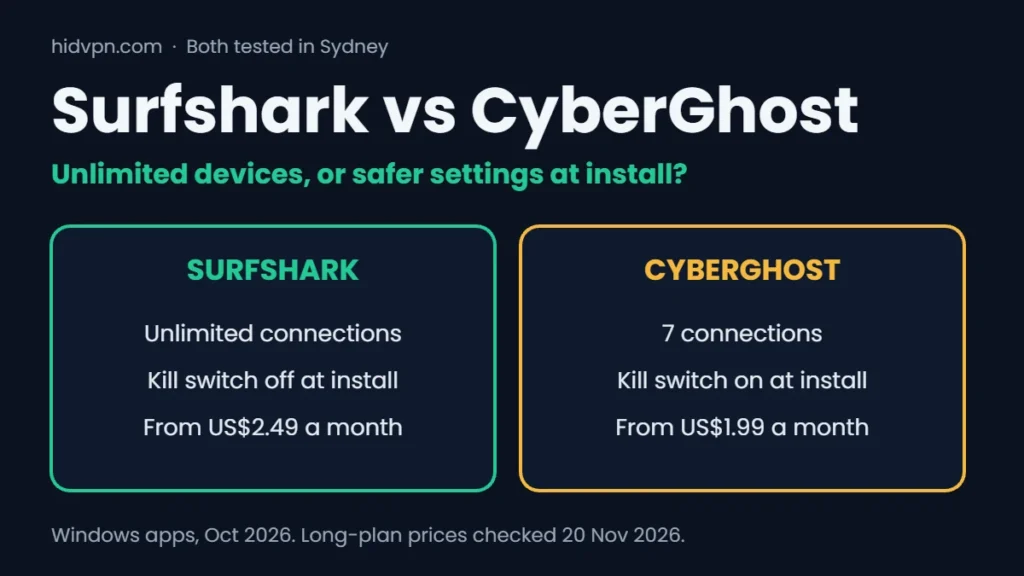
Surfshark and CyberGhost are both cheap on long plans and both did well in our Sydney tests. Two practical differences stand out. Surfshark lets you connect unlimited devices at once; CyberGhost stops at 7. And CyberGhost’s Windows app had its kill switch on from the start, while Surfshark’s was off.
We tested both full apps on Windows 11 on our home Telstra connection in Sydney, on different nights, connecting to a Sydney server and a Los Angeles server with each. Below is what we measured, what each app does out of the box, who owns each company, and what they cost on 20 November 2026.
Key takeaways
- On Sydney servers neither showed a slowdown we could measure against that night’s no-VPN speeds. To Los Angeles, both kept most of the download speed and lost about half the upload or more.
- Connected to Sydney, neither exposed our real IP address, a WebRTC address or a Telstra DNS server.
- CyberGhost’s kill switch and DNS leak protection were on by default. Surfshark’s kill switch was off.
- Surfshark allows unlimited simultaneous connections; CyberGhost allows 7.
- Both belong to larger groups: Surfshark merged with Nord Security in 2022, and CyberGhost has been part of Kape Technologies since 2017.
On this page
The two at a glance
| Surfshark | CyberGhost | |
|---|---|---|
| Simultaneous connections | Unlimited | 7 |
| Servers (provider’s figure, 20 Nov 2026) | 4,500+ in 100 countries | 9,700 in 100 countries |
| Kill switch in our Windows install | Off by default | On by default |
| Ad and tracker blocking | CleanWeb (off by default) | Block content (off by default) |
| No-logs audits | Deloitte, 2023 and 2025 | Deloitte Romania, 2022, 2024 and 2025 |
| Parent company | Merged with Nord Security (2022) | Kape Technologies (since 2017) |
| How we tested | 7-day trial on a 12- or 24-month plan (payment method needed), 22–23 Oct 2026 | 24-hour Windows trial (no card), 10 Oct 2026 |
Both tests used the full app on a trial, not a cut-down free version. They ran on different nights, though, and home broadband varies from one evening to the next. That’s why every speed result below sits next to the no-VPN speed from the same night.
Speeds to Sydney and Los Angeles
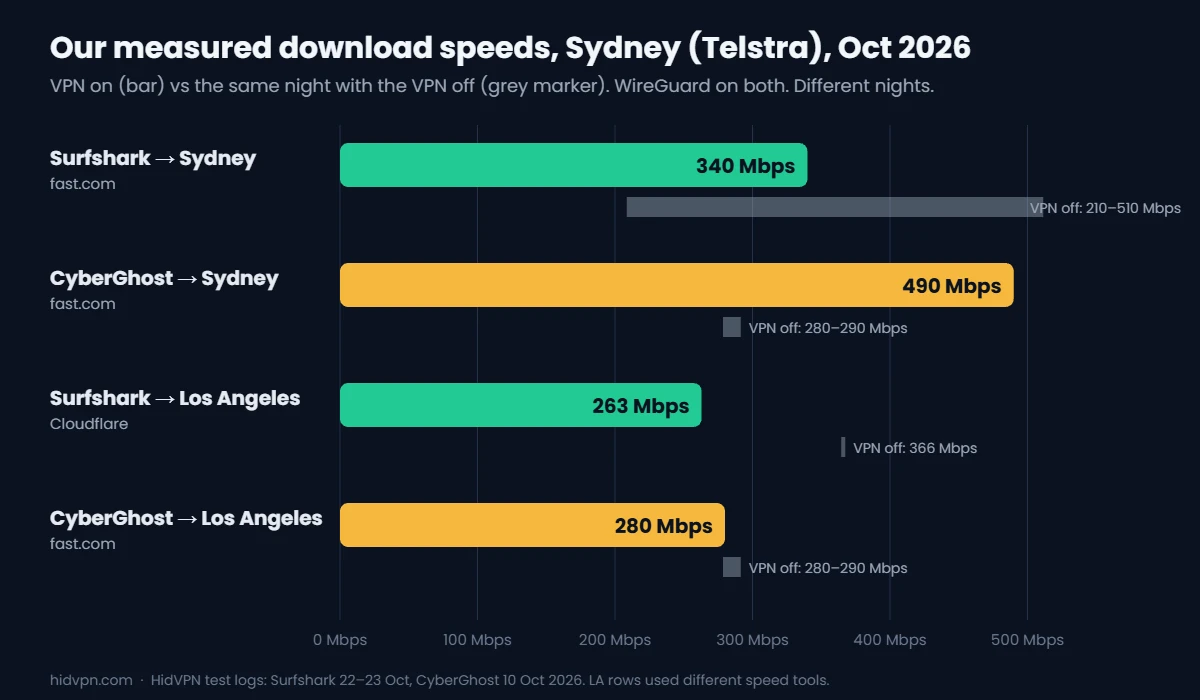
Both apps connected over WireGuard in every speed test below.
| Test | Download / upload | Same night, VPN off | Latency |
|---|---|---|---|
| Surfshark → Sydney | 340 / 48 Mbps | 210–510 / 48–53 Mbps (fast.com) | 8 ms |
| CyberGhost → Sydney | 490 / 45 Mbps | 280–290 / 44 Mbps (fast.com) | 7 ms |
| Surfshark → Los Angeles | 263 / 29 Mbps | 366 / 54 Mbps (Cloudflare) | 148 ms |
| CyberGhost → Los Angeles | 280 / 19 Mbps | 280–290 / 44 Mbps (fast.com) | 180 ms |
On the Sydney servers both results landed inside, or above, that night’s no-VPN range. A reading above the baseline doesn’t mean the VPN made the line faster. Home speed tests bounce around, so a small drop could hide inside that range; what we can say is that neither showed a slowdown we could measure.
Los Angeles is a tougher test, because the 12,000 km trip adds delay. CyberGhost held its download at the baseline but kept only about 43% of the upload. Surfshark kept about 72% of its download and 53% of its upload. Surfshark’s LA test ran on Cloudflare’s speed test because fast.com wouldn’t load on that server, so don’t use these two rows to rank them. Latency rose to 148 ms and 180 ms, mostly from the distance across the Pacific.
Based on these speed and latency checks, you’d struggle to tell the two apart on a local Australian server. We didn’t compare browsing or video calls directly.
Leak results from a Sydney server
We ran the same checks on both while connected to Sydney:
- IP address (ipleak.net): each showed a Sydney VPN address: Surfshark’s hosted by Datacamp, and CyberGhost’s by GSL Networks. Our Telstra address didn’t appear on either.
- WebRTC: both showed only the VPN address.
- DNS (dnsleaktest.com): each returned a single Sydney DNS server on the VPN’s network: Surfshark’s own, and one on GSL Networks for CyberGhost, the same host as its VPN address. No Telstra DNS server appeared on either. Our guide to DNS leaks explains why that matters.
- IPv6: we couldn’t judge this on Windows for either one, because the laptop’s IPv6 test showed “not reachable” even with the VPN off on both nights. On the iPhone, Surfshark did block IPv6 while connected. We didn’t test CyberGhost on a phone.
Out of the box: which settings are on
We looked at each app’s privacy settings straight after installing, before changing anything.
| Setting | Surfshark (Windows 6.20.0) | CyberGhost (Windows trial) |
|---|---|---|
| Kill switch | Off | On (“Automatic Kill-Switch”) |
| DNS leak protection | No separate setting seen | On (“Prevent DNS leaks”) |
| Ad, tracker and malware blocking | Off (CleanWeb) | Off (Block content) |
| Connect automatically | Off | Not checked |
If you choose Surfshark, open the app’s VPN settings and turn the kill switch on. Without it, a dropped VPN connection can send your traffic over your normal connection until the app reconnects. We checked the settings, not how each kill switch behaves during a drop. Our kill switch guide shows how to test that it works.
CyberGhost’s defaults suit people who install an app and never open its settings. With Surfshark, you need to change one setting yourself.
Who owns each, and what Deloitte checked
Surfshark is run by Surfshark B.V. in Amsterdam. In February 2022 it agreed a merger with Nord Security, the group behind NordVPN. The two say they still run as separate services with their own apps and servers. Deloitte reviewed Surfshark’s no-logs claims in 2023 and again in a report announced in June 2025, and Surfshark says its servers run from RAM only.
CyberGhost has been part of Kape Technologies since 2017. Kape is UK-based and also owns ExpressVPN and Private Internet Access. It was called Crossrider until 2018, a history some privacy-minded readers weigh up before buying. Deloitte Romania has checked CyberGhost’s no-logs claims three times, in 2022, 2024 and 2025. The 2025 review covered its VPN server network, configuration and change-management processes, and its dedicated IP system. CyberGhost also publishes a quarterly transparency report on the legal requests it receives.
Both have had recent no-logs reviews from Deloitte firms. An audit shows what the auditors saw during the review period. It can’t prove a company never logs anything, which our explainer on what “no logs” means goes into.
Server lists, split tunneling and extras
Server lists. Both let you choose a country and city. CyberGhost’s list also groups servers into categories, such as gaming servers and dedicated IP locations, which helps if you don’t want to pick a server yourself. Surfshark’s app splits its list into tabs: Locations, Static IP, MultiHop and Dedicated IP. Some Surfshark locations are labelled “Virtual”, which usually means the server sits in a different country from the one it’s listed under.
Split tunneling lets you choose what goes through the VPN. On Windows, CyberGhost’s version works by website rather than by app: you list sites to send outside the tunnel, it’s off by default, and it needs the OpenVPN protocol. CyberGhost says app-based split tunneling is available on Android, which we didn’t test. Surfshark’s help centre says its Windows app can keep chosen apps and websites out of the VPN, or send only chosen apps through it. We didn’t test Surfshark’s version either. See our split tunneling explainer for when it’s worth using.
Extras. Surfshark includes Alternative ID on every plan (a made-up identity and a forwarding email address for sign-ups), plus MultiHop, which routes you through two servers, and Camouflage mode, which makes VPN traffic harder to spot. At checkout it offered a dedicated IP and a US phone number as paid add-ons. CyberGhost offers a dedicated IP as an add-on too. Its main extras are its labelled server categories and its content blocker.
Prices on 20 November 2026
Both pricing pages showed introductory prices in US dollars:
| Plan | Surfshark Starter | CyberGhost |
|---|---|---|
| Longest plan | US$67.23 for the first 27 months (about US$2.49 a month) | US$55.72 for the first 28 months (about US$1.99 a month) |
| Middle plan | Not listed on the page we checked | US$41.94 for 6 months |
| Monthly | Not listed on the page we checked | US$12.99 a month |
| Connections at once | Unlimited | 7 |
CyberGhost’s long plan costs a little less for the first term, and Surfshark covers more devices for the money. If you need more than 7 devices connected at once, Surfshark is the one that allows it. Check the renewal price at checkout as well as the first bill, and your bank may charge a fee for paying in US dollars. Prices change often, so check the current plan before you buy. Our VPN pricing comparison tracks 17 providers.
Picking between them
Surfshark suits you if your household has more than 7 devices, or if you want Alternative ID for sign-ups. Turn the kill switch on after you install it.
CyberGhost suits you if you want the lower first-term price on a long plan, a kill switch that’s on from the start, and servers grouped by what you want to do.
Our full Surfshark review and CyberGhost review have the full notes from these tests. CyberGhost vs NordVPN and Surfshark vs NordVPN compare each with NordVPN, and our Surfshark alternatives guide covers four other VPNs we’ve tested.
FAQ
Is Surfshark better than CyberGhost?
Not overall. In our Sydney tests both were fast on local servers and neither leaked. Surfshark is better if you need more than 7 devices. CyberGhost is better if you want its kill switch on from the start and a lower first-term price.
Which is faster, Surfshark or CyberGhost?
On Sydney servers we couldn’t measure a slowdown from either. To Los Angeles, CyberGhost kept more of the download and Surfshark kept more of the upload, and the two tests used different speed tools, so neither one came out clearly ahead.
How many devices can I use with CyberGhost?
Seven at once, on every plan, according to CyberGhost’s pricing page. Surfshark has no limit.
Who owns CyberGhost?
Kape Technologies, a UK-based company that also owns ExpressVPN and Private Internet Access. It has owned CyberGhost since 2017.
Is Surfshark part of NordVPN?
Surfshark merged with Nord Security, NordVPN’s parent group, in 2022. Both say they still run as separate VPN services.
Does CyberGhost have a free trial?
We used a 24-hour trial in the Windows app in October 2026, and it didn’t ask for a card. Surfshark’s 7-day trial, by contrast, needed a payment method. Trial offers change, so check each site for what’s available now.
Read our Surfshark review Read our CyberGhost review
Sources
- HidVPN test logs: Surfshark, 22–23 October 2026 (Windows 11 app 6.20.0 and iPhone, Telstra, Sydney); CyberGhost, 10 October 2026 (24-hour Windows trial, Windows 11, Telstra, Sydney)
- Surfshark Trust Center: audits, company address, server count (checked 20 Nov 2026)
- CyberGhost: third Deloitte Romania audit (8 Dec 2025, updated 24 Feb 2026)
- MarketScreener: CyberGhost’s 2022 Deloitte audit and Kape ownership
- Tom’s Guide: Who really owns your VPN (11 Oct 2025)
- CyberGhost quarterly transparency report, Q4 2025
- CyberGhost server list: 9,700 servers, 100 countries (checked 20 Nov 2026)
- Surfshark Help Centre: split tunneling on Windows
- CyberGhost pricing and Surfshark pricing (both checked 20 Nov 2026)